Light Rail in or over downtown Raleigh?

As a reminder, there are some transit related events that are going on right now. Remind yourself by clicking here if you’re not sure what I’m referring to. Anyway, two events are taking place in Raleigh this week and the downtown portion of the light rail plan is sure to bring controversy.

Some of the presentation materials have been posted online and I’d like to cover some of it here.

An excellent read, with images that I will be linking to, is over at The Indy. I recommend reading that first.

Rail route is blurry through downtown Raleigh via Indyweek.com

To recap, planners have a few alternatives to work with when the light rail trains, coming from the west, head towards downtown Raleigh. If you look at the initial alternatives study, the map of those routes look like the spaghetti bowl below.
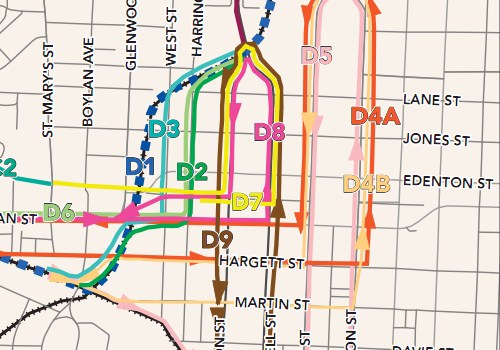

Click for full, larger view.

The next step planners took to eliminate some of these routes was to look at each one and evaluate them on five parameters:

  • Potential Transit Ridership
  • Consistency with Plans and Studies
  • Stakeholder Support
  • No Irresolvable Environmental Impacts
  • Technical and Financial Feasibility

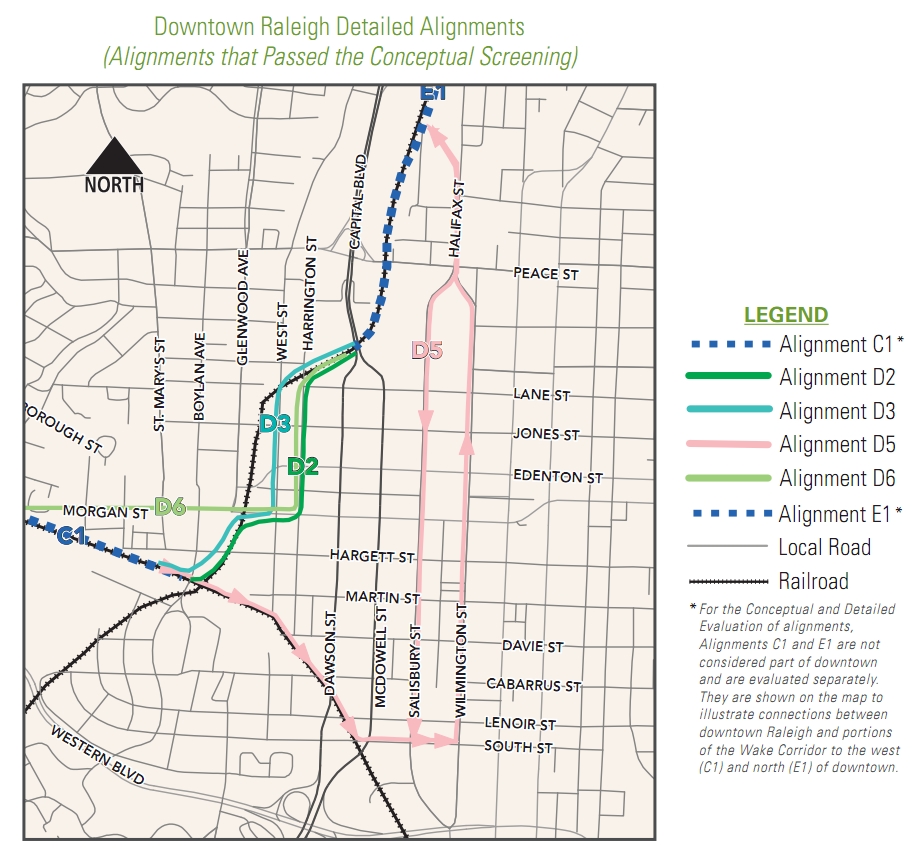
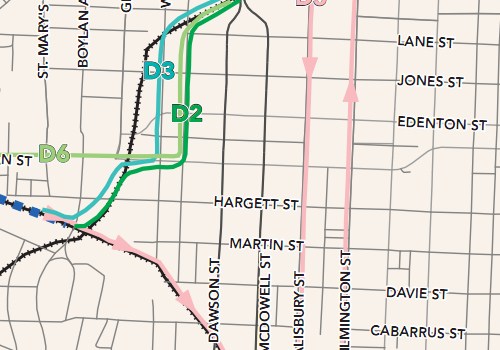
If one of these parameters failed for the studied route, it was thrown out. After that elimination round, we were left with this map.

Click for full, larger view.

Four plans remain and it will be these four that are open for comment at the Triangle Transit events this week. We can step through each one and take a look.

D2 and D3

D2 and D3 are similar except for the street they head north on when leaving Union Station. D2 would have tracks on Harrington Street while D3 would put the tracks on West Street. Both routes bring the trains on a flyover over the Boylan Bridge and would result in something like you see here and here.

As the trains head to downtown from NC State in the NC railroad corridor, “difficulties” in having the light rail line play nice with freight and future high-speed rail are why the plans to go into the air are on the table. I’ll admit the Boylan Wye is a complicated cluster of tracks but the freight rail companies do have a reputation of being against anything that could possibly disturb their operation.

According to planners, D2 and D3 would make the light rail line go right into Union Station, giving us that very important connection to other modes of transportation. It also avoids headaches with the track layout of the Boylan Wye.

These plans were moved forward because each one:

  • Capitalizes on potential development opportunities on the west side of downtown.
  • Serves both Glenwood South and downtown.
  • Does not include additional overhead structures.
  • Supports location of proposed Raleigh multimodal center (Union Station) concept.
  • Meets the Purpose and Need for the project

I’m not quite sure I agree with these. A train that goes into the air and weaves through downtown blocks may actually take away from development opportunity because it is consuming so much space for itself. Once the train weaves through, that land cannot be developed.

I haven’t been to a meeting yet so I’ll find out for myself later this week.

D5

D5 involves the same flyover going over the Boylan Avenue Bridge but instead of heading to the northern end of Union Station it goes south, towards the convention center. The line would run through the core of downtown, along Salisbury and Wilmington Streets, and back into the NCRR corridor to the north.

My feelings are the same with the flyover over the bridge but I’m not quite sure when the train finally touches down. This rendering and this rendering suggests that the train will most likely continue to be elevated all the way to South Street. Another thing to note is that other routes were turned down because they impact traffic on Dawson and McDowell Street. This leads me to think that D5 will continue to be elevated on South to go over McDowell and come down before Salisbury Street.

Again, lots of elevated tracks that take away from development opportunity. This plan passed because it:

  • Does not cross McDowell and Dawson Streets at-grade.
  • Penetrates core of downtown Raleigh.
  • Does not impact Morgan, Hargett, and Martin Streets.
  • Provides more direct access to the Convention Center.
  • Meets the Purpose and Need for the project.

D6

No renderings are provided for this scenario. Interesting.

D6 avoids the Boylan Wye and the possibility of going over the Boylan Avenue Bridge. The plan has the light rail line coming out of the NCRR corridor down by Charlie Goodnight’s and it hits the street at Morgan. It continues East and takes a left turn onto Harrington Street and continues on its merry way. According to the report, the plan:

  • Avoids Raleigh Wye and does not interface with freight and Southeast High Speed Rail track issues.
  • Does not include additional overhead structures.
  • Capitalizes on potential development opportunities on the west side of downtown.
  • Serves both Glenwood South and downtown.
  • Meets the Purpose and Need for the project.

The negative with this plan is that if the light rail line went down Morgan Street, the optimal station stop would be at the intersection of Morgan and West Street, the Union Station stop. But if you’ve been out there to see it, Morgan is not quite so flat in that area, a requirement for a light rail station to be ADA compliant. I’ve heard this is also the more expensive alternative, but will confirm at the meeting, because a lot of road work would have to be done to get that Union Station stop, something that is very important to the connectivity of the system.

Wrapping Up

I like to see all the materials first before I choose which direction to take my opinion but from what I have seen so far, the D6 route seems to be the best choice on the limited amount of information available.

D6 is the most pedestrian friendly and turns downtown streets into more efficient modes of transit, moving more people through without building more roads or widening them. In my opinion, trains on elevated tracks that are not over roads take away from potential development.

I’d be really interested to see what kind of road modifications need to be done to Morgan to get that Union Station Stop at the West Street intersection. This will likely be my first question to answer at the meetings.

The Mayor’s Passenger Rail Task Force supports a route similar to D6 and the Downtown Living Advocates are speaking out for the same thing.

Whatever your opinion may be, make sure to send it in.
Transit Related Events and Links You Need To Know About

Watch the video “Overview of the Triangle Regional Transit Program (TRTP)” on YouTube

Later this month are some transit related events that are worth talking about. This round of workshops are particularly important because they are the last ones of the Alternatives Analysis.

For those that are not caught up, the Alternatives Analysis has been going on throughout most of 2010 up until now. Each piece of all the proposed transit corridors in the Triangle have different plans for them, or alternatives, for us to choose from. (or not to) With a lot of research and public comment, we are close to creating what is called the Locally Preferred Alternative. (LPA)

To move forward with this LPA, you need to send in your comments towards the plans that are out there and these meetings this month are the best place to do it. They are the final round before the LPA’s are chosen. The dates and locations for the meetings are:

  • Tue, Mar 22, 4 – 7 PM | Triangle Town Center, space 1001, next to Dillard’s, Triangle Town Blvd, RALEIGH.
  • Wed, Mar 23, 4 – 7 PM | Durham Station Transportation Ctr, 515 W. Pettigrew St., DURHAM.
  • Thu, Mar 24, 4- 7 PM | The Friday Center, 100 Friday Center Drive, CHAPEL HILL.
  • Mon, Mar 28, 6 – 9 PM | Mt. Peace Baptist Church.1601 Martin Luther King, Jr. Blvd., SOUTHEAST RALEIGH.
  • Tue, Mar 29, 4-7 PM | Cary Senior Center in Bond Park, 120 Maury O’Dell Place, High House Rd. between Cary Parkway and NW Maynard Rd, CARY.
  • Wed, Mar 30, 4-7 PM | McKimmon Center, NCSU, 1101 Gorman St, RALEIGH.
  • Thu, Mar 31, 4-7 PM | RTP Foundation, 12 Davis Drive, RESEARCH TRIANGLE PARK.

There is no formal start time to these meetings and no presentations will be given. You can show up when you can, look at the large maps, read the information and ask questions. At the end, any comments you leave will be taken into consideration for the final plan.

From what I’ve heard, the downtown Raleigh piece has been the most difficult to fit into place. Trains heading east towards downtown inside the NC Railroad corridor will either stay inside it until Union Station or glide off onto Morgan Street, each scenario presenting its own types of problems. One alternative has the trains flying over the Boylan Bridge.

If you do take the time to look at each alternative, remember that these are just different scenarios and that comments not supporting any of them are OK. I hope what will be presented is promising and that this does not turn into another dramafest like last summer with the high-speed rail meetings.

To further get your transit on, here are some links for you to explore. This blog supports transit in the Triangle and now has the links in the sidebar for future use.

Also, dive into the videos in this post created by the TRTP to promote the transit plan and encourage public feedback.

Watch the video “TRTP Alternatives Analysis Process” on YouTube

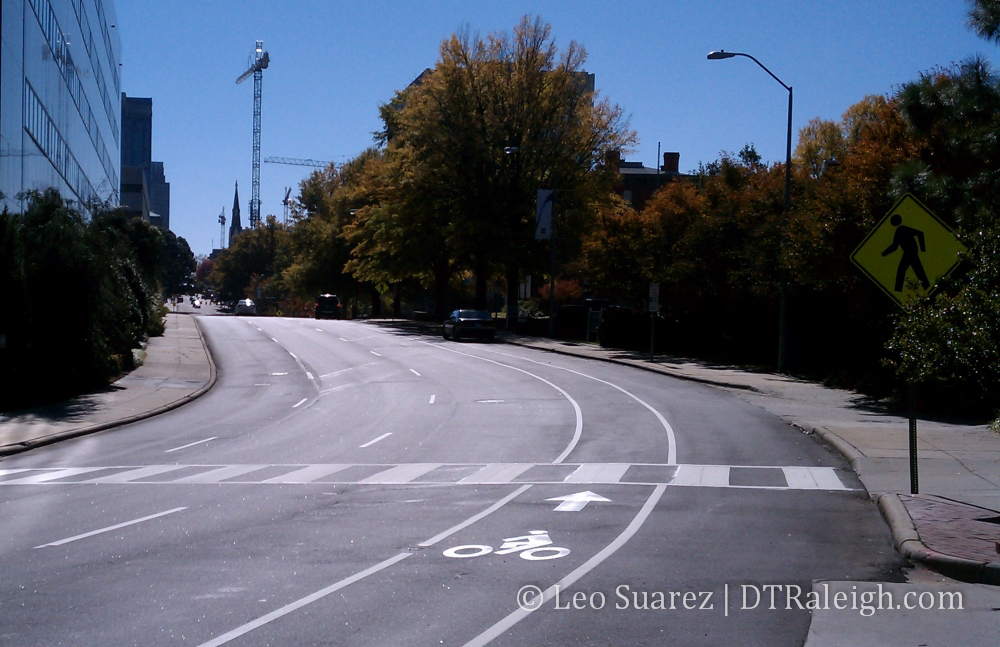
Salisbury Street Bicycle Lane

I stumbled upon this new bicycle lane on Salisbury Street yesterday. The lane goes from Peace to Lane Street which, right now, is not much but the Green Square construction kind of gets in the way. In the end, the bicycle lane should continue south down Salisbury and end at Martin Luther King Jr. Blvd.

This is the beginning of some of the priority bicycle lanes that will be installed around Raleigh and you can see the plans at RaleighPedBikeMap.com.

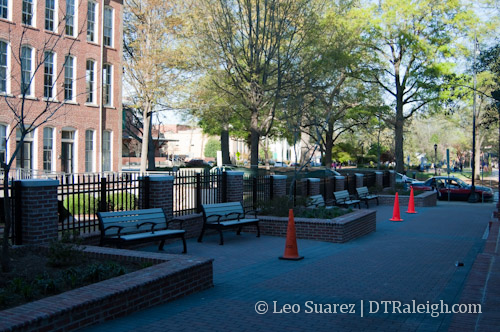
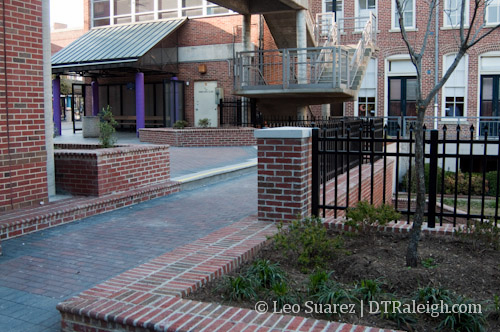
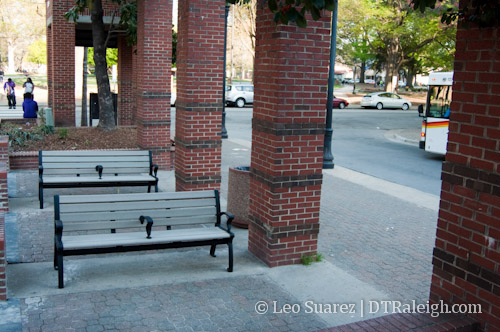
Walkways and Seating Coming To The Moore Square Bus Station

I have seen this work going on at the Moore Square bus station for a few weeks now but it was only today that I noticed the signs around the construction fencing. They say that new lighting, walkways, and seating will be put into this area.

As someone who walks here a few times a week to ride, the added room is welcome. At certain times of the day, the sidewalks are jammed with people. Hopefully this is one of many future additions that Raleigh’s central transit station should have in place.

High Speed Rail Noise versus Freight Noise

I watched some of the city council meeting last night and train noise was a pretty hot issue, one of the bullets the Five Points residents were firing off as to why they were against the NC3 option. What I hope, very much hope, is that the good citizens in the Glenwood-Brooklyn neighborhood and the Five Points neighborhood are against the noise coming from a high-speed train and do not think it sounds the same as a freight train.

If you are not caught up on the high-speed rail corridor debate, hit the archives tagged SEHSR here.

I support the NC3 option, with the added removal of the Hargett Street bridge, and want to wait for more details about this new NC4 option before I even touch it. I think some more investigation with this noise issue is needed because Norfolk-Southern, who is against the NC3 option, has definitely helped organize the citizens in the previously mentioned neighborhoods against new trains going through here at all. They are obviously concerned about their interested, very little or not at all concerned about ours.

A comparison has to be made here; freight versus passenger trains. In my opinion, these higher capable speed trains WILL sound different then the freight trains that go through there. This comes from my experience riding and being around trains in Asia. The passenger trains are built better probably because people will be on board and not cargo. You don’t get the clatter and clacking noise from freight trains. Hopefully NCDOT can provide better data on noise because I thought they did a very poor job answering the council’s questions about train noise last night.

Here are some random videos that are relevant to this topic. You can make up your own mind.

Freight versus High Speed rail Noise Impact on the Frankfurt-Cologne line.

Diesel cross-country train going through Shawford Station

A very quiet electric locomotive leaving a station.

Pic of the Week


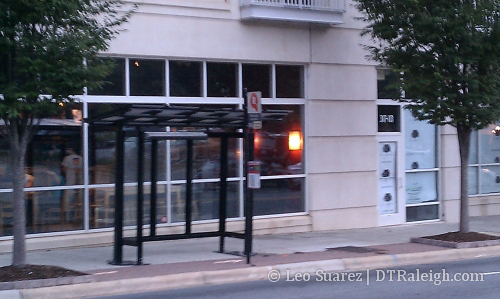
Bus shelter on Morgan Street taken with my camera phone.

A bus shelter has popped up on Morgan Street at the R-Line stop near the intersection with Dawson Street. Bus shelters were on the to-do list for Capital Area Transit so hopefully more are on the way, especially with the colder season just a few months away.

Reminder: Downtown To RDU Direct Bus Route Starts Today


The trusses of Terminal 2. Picture by southpaw20, on Flickr

This is just a quick reminder that a slew of new Triangle Transit bus route changes are in affect as of the moment you read this. Most important to highlight to readers of this blog is Route 100, starting at Moore Square in downtown Raleigh, with stops at both terminals at the RDU airport, and ending in Research Triangle Park.

Here is Triangle Transit’s link to everything that involves a green bus and airplanes. Take note that this only costs two bucks one way.

Triangle Transit – Airport To and From

High Speed Rail Meeting Tonight


Tonight is the public hearing for the Southeast High Speed Rail (SEHSR) Tier II environmental study. In short, this study breaks up the rail path from downtown Raleigh to Richmond, Virginia into subsections. Most subsections have a few alternate plans and tonight’s event is an opportunity for you to comment on them. The event starts at 5:00pm and anyone will be able to leave feedback or ask questions about any part of the rail line. At 7:00pm, several people will speak about the project and present material to the attendants. Here’s the event info:

SEHSR Tier II DEIS public hearing
5:00 – 7:00 p.m. followed by public hearings at 7:00 p.m.
Raleigh Convention Center – 500 South Salisbury Street

Read more about the event at SEHSR.org

We have already discussed the planned options on the table relating to downtown Raleigh so in preparation for tonight’s hearing, here are two thoughts to add.

Elevated Jones Street

The closing, or “retirement” in NCDOT’s words, of Jones Street at the rail crossing should be the hot topic between downtowners. One option, the CSX corridor option, proposes elevating the street over the tracks. This means that from Boylan to about Harrington, Jones would be raised off the ground. To help paint that picture, imagine the top of the street being as high as the roof of the building 518 West is in. That would mean that the next time Google Street view updates its images, this view would be a good 20 to 25 feet higher.

Let it sink in.

I’ve read the reports and walked the area, this option just does not seem to click with me. Whoever drew up this idea must not live or work in downtown. They had to of visited in a car, surveyed the area in a car, and its possible they sleep in one every night. Even if built, someone driving on Glenwood Avenue would have to turn off Glenwood, turn at Boylan Avenue, and then turn onto Jones Street in order to cross the tracks. There won’t be an on ramp put up to get you from Glenwood to Jones Street.

So the new Jones Street would further ruin the grid-like structure we have near the south end of Glenwood South, making it a little more confusing to navigate by car, pedestrian and bike access would be limited, and the Jones/Glenwood intersection would not be aesthetically pleasing. It may also create more car traffic on Boylan Avenue, which is lined with single family homes and this may lower the desirability for people to live here.

The planners say that throwing Jones Street into the air over the tracks is to maintain connectivity of Glenwood South to the rest of downtown. The CSX plan also closes Harrington and West where the tracks cross so this would help keep the area isolated. In my opinion this is the most invasive option. I wish I had numbers for this but in my opinion, cars mostly run up and down West and Harrington while pedestrians mostly cross the tracks at Jones. The closings and the elevated street would cut off the primary users.

If you can’t go over, go under

One idea that many are not talking about is the idea of burying the train. Immediately people snap back about how expensive it is and that it will probably flood during the 200 hurricanes we get each year. Also, the politics behind getting this done are out of Raleigh’s league. We’ll get to this shortly.

Five Points residents are really interested to see what happens to the Fairview Road train crossing. If the Norfolk-Southern option is chosen, this crossing would be closed. Why hasn’t the option to run the trains under this road been explored?

Looking at a map, the train would roll into town from the north and go under Wake Forest Road, like it does today. They would then turn and head through the Norfolk-Southern rail yards before hitting Fairview Road. This is where the train could ramp underground, go under Fairview, under Wade Avenue, under Peace Street, Johnson, Tucker, North, and Jones Street. It would finally pull into Union Station by Hargett Street at a lower elevation.

Did you follow that? Here’s a map.

The benefits of this option is that there would be no disruption to the current street layout, except during construction most likely. The train would go into Union Station at a much lower elevation but so what, Union Station hasn’t been designed yet! Also when the train continues west to Cary, it has all that room by NC State to ramp up back to grade level. No street closures, no train noise, no problems.

But with all the pros comes the cons.

The cost of this idea would easily be many times more then anything currently on the table. I would be a little nervous about going with the most expensive option. However, I’m the guy that spends a little extra to buy the quality brand in order to get more in the long run.

One could make the argument that running the train underground and not disrupting the growing entertainment and residential district would pay off in the long run. Union Station may spur lots of development in Glenwood South, maybe much more if streets are not closed and Jones Street is not elevated. Development on existing infrastructure is also great. That’s more tax dollars for the city brought in by visitors on the train.

If obstacles are placed in Glenwood South, the hassle may hurt. A less walkable district could lower the amount of condos being built in the future. A less accessible entertainment district may result in less conventions being booked. A confusing street grid may bring less visitors from around the Triangle, who arrive by car, and these mobile visitors can easily go elsewhere with their thirst, hunger, and money.

The politics behind modifying the Norfolk-Southern lines here, I’m guessing, would be a huge undertaking and those in the know are probably laughing while reading this. It is definitely not in Norfolk-Southern’s interest, just running it in their corridor has them upset, as was the intent of a meeting near Five Points this past Saturday.

Does Raleigh have what it takes to get the high-speed train to run the way it wants or will we approve whatever option has the least resistance?

And why is this “non-disruptive”, as far as I know, option not even on the table? Yes, I know it would be expensive but to not even present it to us, the citizens, is bad a service to us, the ones that walk the streets around here.

Alright, almost done

It’s obvious I have given this a lot of thought and I think it is a much bigger deal then people think. I’m behind all the support for a beefed up train network in this country and would love to see Raleigh as the gateway to the south with the new high-speed rail line.

These transit events, if like others, are great for getting questions answered and just having conversations with the experts about what the plans are and what ideas have been thrown around. I encourage everyone to weigh in with their opinions, not here on the blog but on the SEHSR website. Here is a link to their survey where you can tell them what you think.