The R-Line Is Taking a Break. What Comes Next?

The Raleigh Transit Authority, which I am currently an active member of, has endorsed a plan to rethink the R-Line, our downtown Raleigh bus circulator service. Given low ridership, high cost, and the availability of other mobility options in the downtown area, it may just be time to think differently about how people get around and what needs are not being met. This August, the R-Line will go on sabbatical for a while while the city’s transit staff work on something different — or not, as retiring it completely is still on the table. Let’s take a look at the history and current state of the R-Line.

Continue reading →

R-Line Rolls Through 2020 With a New Route

Downtown mobility keeps changing. After 10 years of running the same route, the R-Line is running a little differently these days.

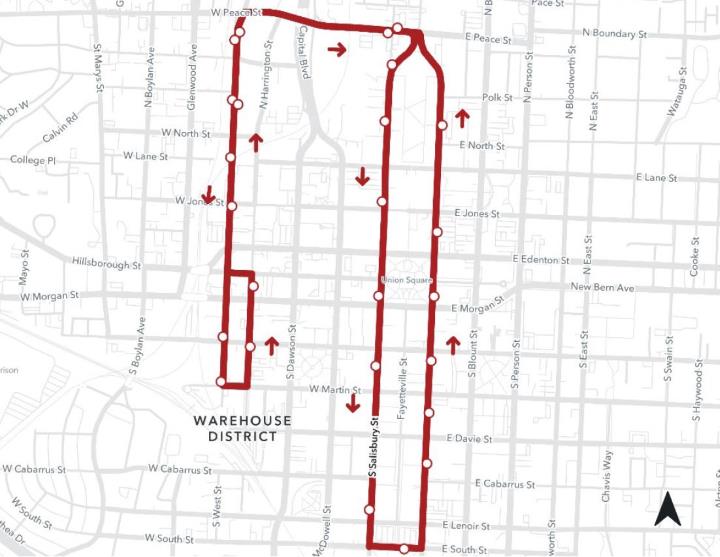
GoRaleigh is now running a new route that has the buses going in a two-way direction rather than the loop that was used throughout the 2010s. The new route should deliver faster and easier service.

The R-Line, more or less, services the same areas of downtown going forward with some locations being only a block away. Key highlights include:

  • Using West Street instead of Glenwood should be quicker
  • Service directly to Union Station and Moore Square Station
  • Salisbury and Wilmington Streets also move faster

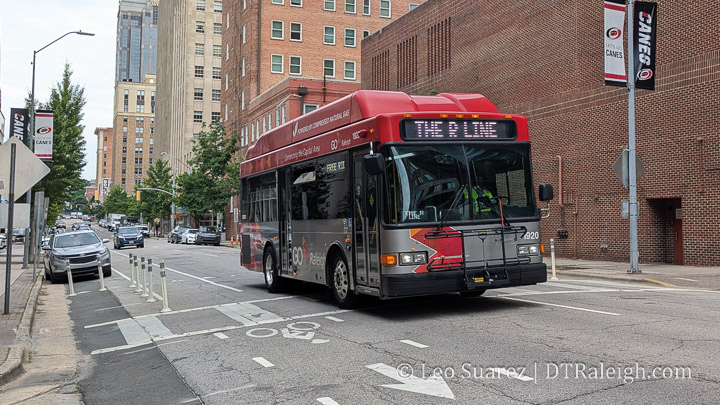
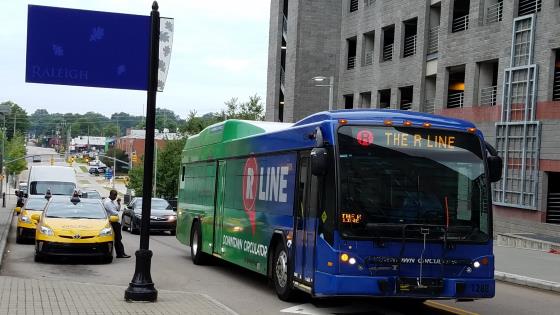
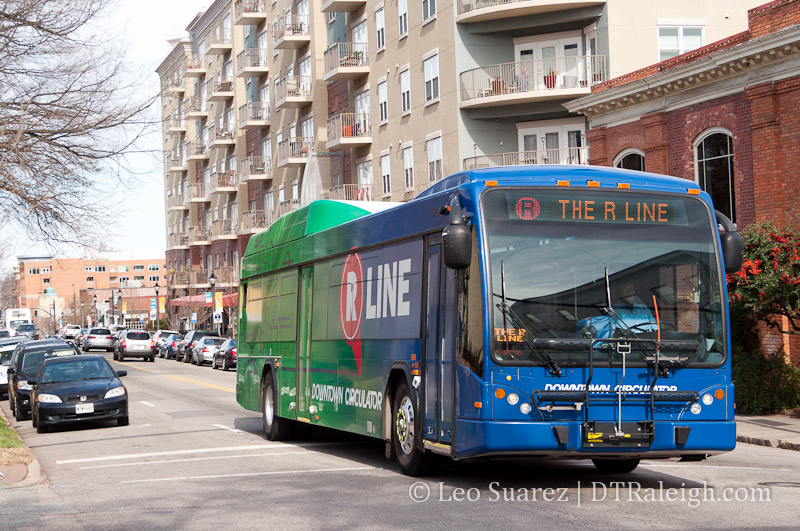
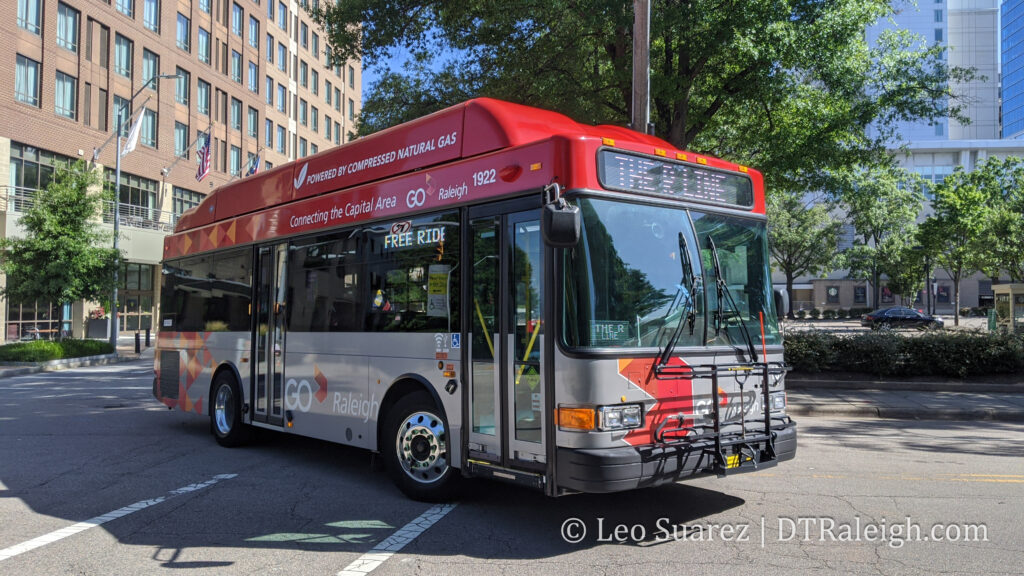
The green and blue buses, from what I heard, are being repurposed elsewhere in the system and new buses running on compressed natural gas are being used. (shown above)

I think this is a nice change and improvement. Tweaks might be needed as BRT lines come online over the next few years but it’s good to see the system adapting a bit.

See more at GoRaleigh.

Discussing the R-Line on Inbound Raleigh

R-Line Bus

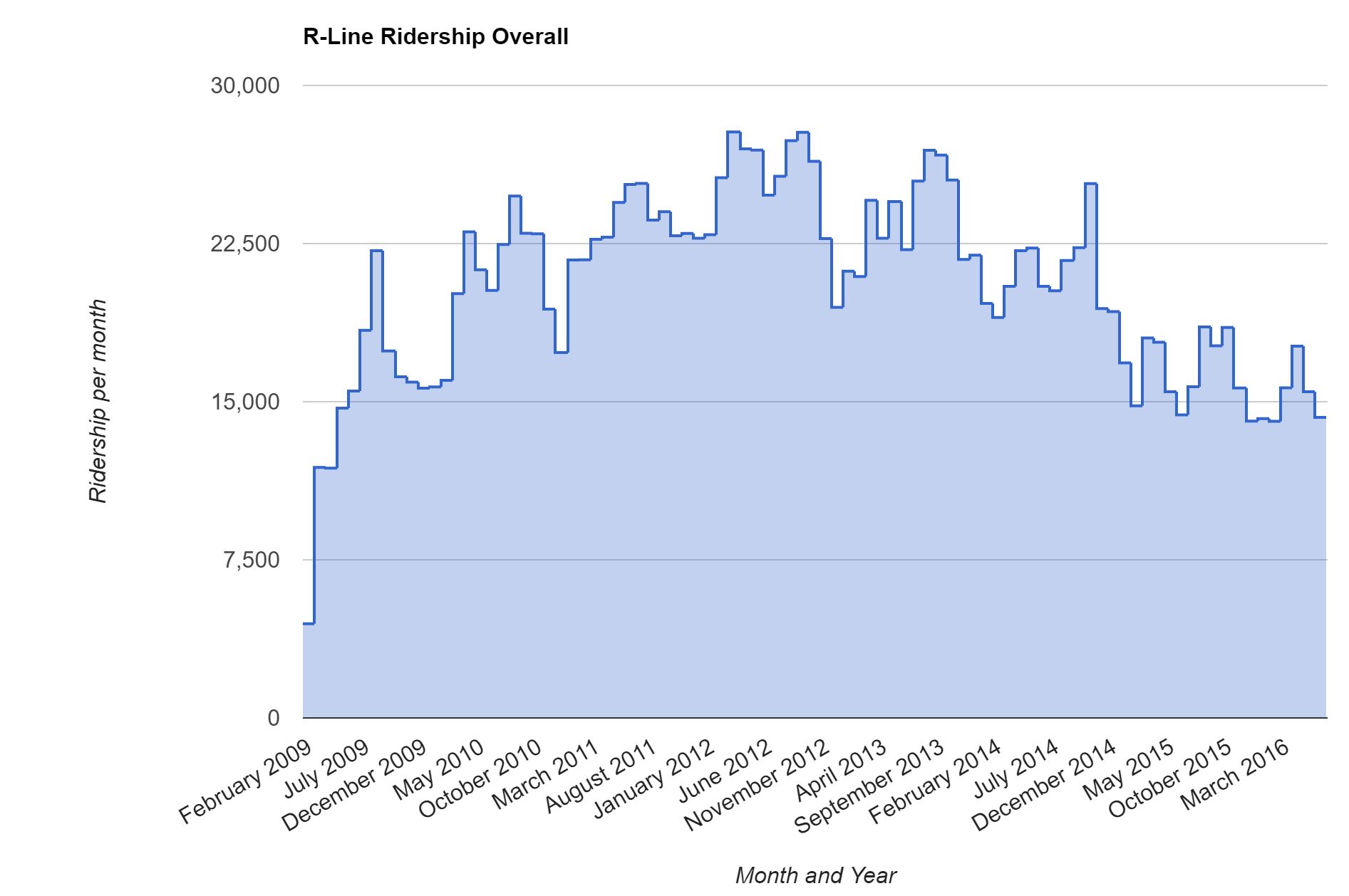
I was recently invited to talk about the R-Line on the Raleigh transit podcast, Inbound Raleigh. We gathered some ridership numbers over the lifespan of the R-Line, which is approaching its eighth birthday in February, and talked about the history of the downtown circulator.

Have a listen and let me know what you think, about the episode and the R-Line in general. You can subscribe on iTunes and most popular podcast-listening apps out there.

Here are some links to the data and images (some from those links) for your reference.

R-Line Ridership Overall

Click for larger

My Thoughts on the R-Line

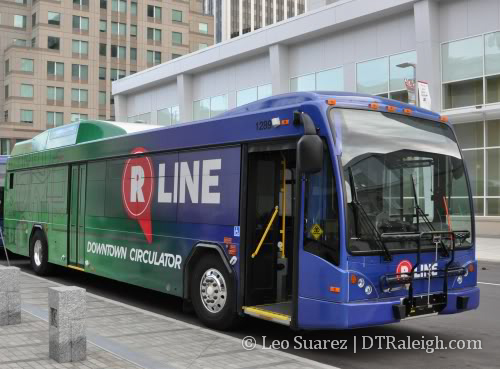
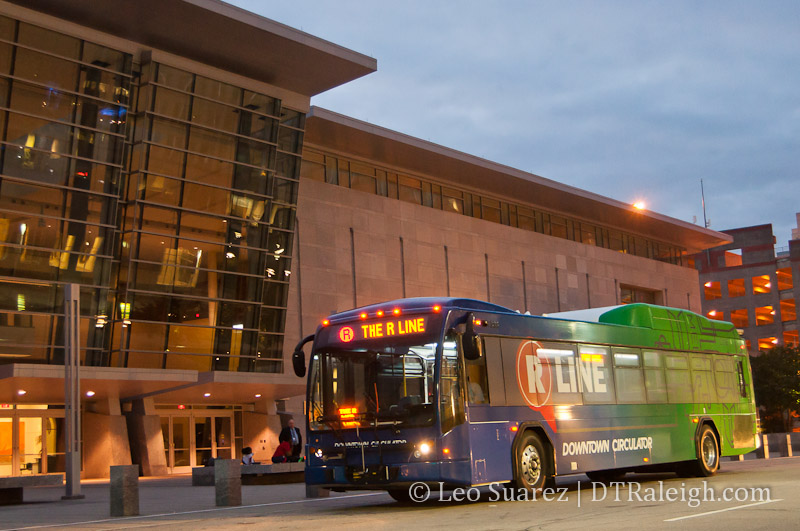
An R-Line bus in front of the Raleigh Convention Center

One of downtown Raleigh’s hot topics this year has apparently been the R-Line. If you’ve been following, there are a slew of stories about the perceived unfairness of the fare-free bus circulator that operates seven days a week. With upcoming fare increases on other routes of the Capital Area Transit (CAT) system, the R-Line is being looked down upon by certain Raleigh individuals.

My take on this is that the R-Line is being politically micro-managed and we should let the transit planners have a say.

Background articles to read:

The route was first introduced in February of 2009 with a dedication ceremony in front of the Raleigh Convention Center. It’s important to note that the R-Line was one piece of a much larger puzzle. The Convention Center had just opened around that time. The Fayetteville Street makeover was still pretty fresh. City Plaza was less than a year old.

These were downtown improvements made to attract more visitors, create more spending, and create more businesses. From a city point of view, that means paying back the investment in downtown and generating more tax revenue. Cities do this to sustain a high-quality of life, which Raleigh has, with a fair or low cost of living.

A lot has happened over the last five years though.

Events have been one of the largest driving forces behind downtown Raleigh’s growth. Fayetteville Street events used to close off one or two blocks. Moore Square events could be contained within the park itself.

Today, downtown is bursting with events.

An interesting statistic would be the growth of attendance and size over the years. I would put money down that that number has increased year after year.

You have a pretty good chance of catching an event on Fayetteville Street on any given weekend these days. From mid-August to mid-October, downtown is crawling with events and people. Spring has another spike in events that seem to take over. Parking decks are as or more full on weekend nights as they are during the workweek hours any weekend of the year.

It also seems that every marathon that comes to town wants to run their route through downtown Raleigh. We’re not talking just a few, but several dozen closing streets on random weekends.

So what does the R-Line have to do with downtown being the host with most?

A strategy (the R-Line) to make our public investments (Convention Center) more attractive became hugely successful and everyone wants to get a piece of it.

And why was it successful? In my opinion, the R-Line is run like most bus routes should be run. No timetables and a higher frequency of buses passing by.

It was also the first city bus route, to my knowledge, in Raleigh to have GPS tracking. Those with smartphones could see the bus location before heading out to the bus stop. With all the amenities and ease of use, it was implemented very well and has become successful.

Over the years, Raleighites have adopted it. The original purpose is still intact, with the buses moving conventioneers around downtown. The event-driven downtown has used it for moving people between venues. The growing resident population has used it to travel between districts. With a stop near the Moore Square Transit Center, CAT riders have also used it as either the first or last leg of their trip when getting around.

With a diversity of riders, sounds like a success story to me.

Today, the R-Line’s fareless system is being picked on. With an upcoming 50-cent increase in fares over the next 2 years on every other CAT route, there are some vocal citizen advocates that think this unfair, with one individual quoted in an N&O article calling the R-Line racist.

Opinions and proposals on the R-Line aren’t hard to find either.

The articles linked above mention issues such as fairness, equity, and cost. Expanding the route would cost more. How can you make the R-Line more fair? Should all riders have equal access and the demographics of riders be diverse?

We’ve definitely lost sight of the original purpose of the service, which is to move visitors (from hotels and the convention center) around downtown.
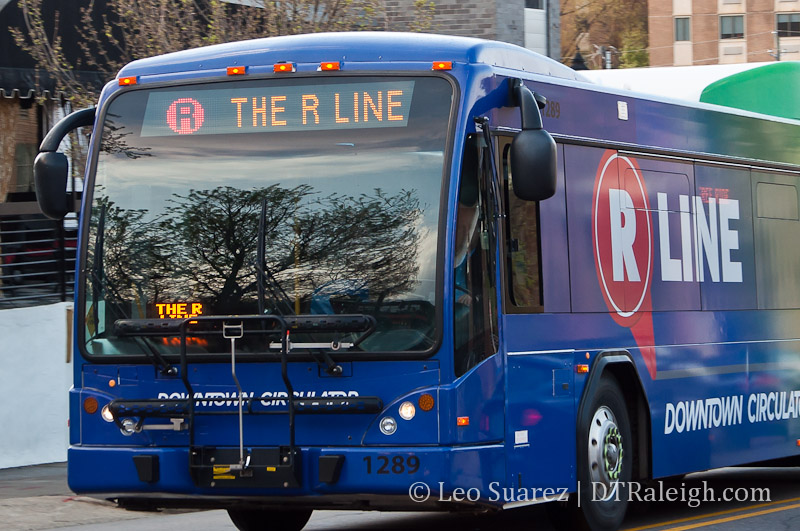
An R-Line bus passing through Glenwood South

What we have today though is a situation where the R-Line is so successful that groups want to either copy the R-Line model or modify the current route to include their neighborhood or business, with complete disregard to the overall system that the R-Line is a part of.

In 2013, the Midtown Raleigh Alliance teased an idea of an M-Line between North Hills and Downtown Raleigh. I wrote about the idea and how it compared to the currently in place Route 8 – Northclift CAT route. They seem similar.

In 2011 and back again this year, Cameron Village and nearby residents are petitioning to change the R-Line route to serve the shopping center and the neighborhoods around it. I wrote about it back in 2011, and it’s pretty applicable this year too, that Route 12 – Method and Route 16 – Oberlin both have been providing a link to and from Cameron Village for years.

You also have residents in Oakwood and Mordecai that think the R-Line should swing more north to serve the growing Person Street District. In the linked articles, there are opinions that the R-Line should go more east instead of turning around Moore Square only. CAT routes serve those communities today.

Finally, I’ve heard that the upcoming 10-year Downtown Plan has a pretty healthy section on the R-Line. The draft release of that is scheduled for September 11, blog post on that soon.

It seems the R-Line has now become politically infested. It works so well that others are upset that it isn’t serving their communities. I predict any outright support for the R-Line would be seen as a politically bad move at this point.

I wrote this in the 2011 post about the R-Line going to Cameron Village:

“In my opinion, the petition just shows this area’s readiness for an upgrade in transit “

Raleigh, you are ready to level up. It is time to put on your big girl pants and commit to moving CAT to the next level.

Raleighites should stop picking on the R-Line and start getting behind seeing more money in the budget for the CAT system. Raleigh should hire some top transit talent to guide us in moving to the next level.

With a cohesive and easy to use transit system, funded by all Raleighites, priced fairly for the service it provides, we will stay on the top 10 lists for decades to come.
Talk of a Midtown Raleigh Bus Circulator, The M-Line, Begins

R-Line Bus in downtown Raleigh

We’re in a lull when it comes to transit news in downtown Raleigh. It feels like the plans are made but the funding of a half-cent sales tax increase to go towards transit improvements is stuck at the county level.

While politicians on the County Commission continue to debate the possible tax increase, one of the most successful transit stories in Raleigh recently has been the R-Line. This fare-less service that circles downtown has been increasing its ridership every year since it was launched in 2009.

So it’s only natural that others around Raleigh want to get in on the great service.

I recently heard of the Midtown Raleigh Alliance’s (MRA) idea of pitching a service called the M-Line, a bus circulator between midtown Raleigh and downtown Raleigh. There’s not much behind this idea really, just talk and a blog post. [UPDATE: Broken link]

Either way, let’s speculate and see if this idea is at all feasible.

According to the MRA, midtown Raleigh is the “area within a 2-mile radius surrounding North Hills.” The about page on their website claims the area has a “Distinctive skyline and 24/7 walkable urban center.”

Whether that’s actually true or not, the most likely place for the M-Line to arrive and depart would be from a spot in North Hills, the most urban area in midtown.

A park and ride situation could work but with parking so plentiful in downtown, once people are in their cars then it’s likely they will just go straight to downtown rather than transfer to a bus.

Using Google Maps, the quickest way from North Hills, the Renaissance Hotel to be more specific, to downtown, the state Capitol, is along Lassiter Mill Road, St. Mary’s Street, and Glenwood Avenue. Google also estimates the trip to take 13 minutes.

The trip could take longer if the route is changed to make more stops around midtown. So to keep the numbers easy, let’s say the trip takes 15 minutes. With one bus running the route, a round-trip takes 30 minutes with an average wait time of 15 minutes.

Compared to CAT

If there is a truly interest in an M-Line, this again shows citizen support for transit and perhaps readiness for this area to increase transit effectiveness.

Capital Area Transit’s Route 8 – Northclift is the closest route that goes from downtown to midtown. It’s similar to the route suggested by Google Maps. Route 8 starts at the Moore Square bus station and goes through downtown, north on St. Mary’s and Lassiter Mill Road to North Hills.

The current operating schedule of Route 8 is:

  • 5:55 AM to 8:52 PM | Monday – Friday
  • 7:00 AM to 8:12 PM | Saturday

The route has frequencies of 30 minutes during rush hour and an hour outside and on Saturday. That makes wait times of being 15 minutes on average during rush hour and 30 minutes outside.

With a similar route already being offered by CAT, supporters of an M-Line have quite a bit of work to do in order to justify it.

Just like my post back in July 2011 about the petition to expand the R-Line to Cameron Village, this is an example where adding another bus circulator would provide redundant service to the current CAT system.

If anything, M-Line supporters should be interested in taking what money that could be put towards this new line and into making Route 8 much more effective through greater frequency and expanded operating schedules.

Municipography: Union Station and R-Line Changes

Municipography is a summary of current issues going through the Raleigh City Council and other municipal departments in the city. The point is to try to deliver any video, photos, and text associated with the discussions happening at City Hall or elsewhere. Since this is a downtown Raleigh blog, the focus is on the center of the city.

I recommend email readers click through to the website to see the embedded video.

At the Raleigh City Council meeting on September 4, 2012, the council discussed funding for the Union Station project as well as approved some changes at the Moore Square Bus Station that will effect the R-Line.

Union Station

During the meeting, council discussed a future commitment of $3 million towards the Union Station project. Comments were generally positive about the station and it really feels that Raleigh and NCDOT want this project to succeed. With a 6-1 vote, the council approved the additional funds.

The city also approved the allocation of funds towards development of a schematic design for the project.

Bus Traffic at Moore Square Station

We haven’t talked about it on this blog before but there have been grumblings about the bus and pedestrian traffic along Wilmington Street and the effect it has on nearby businesses. To catch readers up, I’ll point you to a few articles from the local news media:

Business owners and residents in the Moore Square area met with the City of Raleigh on Tuesday, trying to come up with ways to address loitering, panhandling and bus congestion in the Moore Square District.

*Downtown Raleigh residents decry loitering, panhandling, ‘riff-raff’

Business owners say the crowds, coupled with bus congestion along the street, create an uninviting atmosphere for customers.

*New merchants chafe at crowds from Moore Square bus terminal

Here’s an alternative viewpoint from Barry Saunders at the N&O.

Here’s my advice to the business owners who are so dismayed that a city’s downtown transit center has people occupying various rungs of the social ladder: go out and meet them and talk to them. You may find that they are just like you, except they don’t have a car.

*Saunders: Respect needed among Moore Square’s old and new

Now that you are caught up, at the city council meeting this week, the recommendations from the Law and Public Safety Committee were unanimously approved. Those include:

  • Expand the bus zone on Wilmington Street to relieve bus congestion.
  • Move the R-16 Moore Square Deck station south of Martin Street.
  • The R-Line will now always run along the nighttime route that rounds Moore Square.
  • Immediate upgrades to the Moore Square Station including better pedestrian access, lighting, and safety upgrades.

While this may or may not solve the bus traffic issue on Wilmington Street, the R-Line may be the victim. R-Line riders could potentially experience added wait time as the bus will always make the trip around Moore Square rather than driving straight up Wilmington Street during the daytime operating hours. However, this may be a temporary solution until the Moore Square Bus Station is significantly upgraded for more bus capacity.

Petition For R-Line to Cameron Village Circulates

I saw this link on Twitter of a petition by some Raleigh residents that want the R-Line to be extended to Cameron Village. The petition states:

Lets bring the bus closer to us and bring new crowds over to Cameron Village at the same time.  This petition is to help bring the R-line to Cameron Village for a closer and less hassle way to get downtown and back so you don’t have to worry about finding downtown parking spaces and/or of walking long distances.  Together lets bring the bus to us so that we have a faster connection to downtown Raleigh.

As of this writing, there are over 110 signatures, probably more since I’ve now helped spread the word by blogging about it.

The twitterverse was quick to point out the already running bus routes to Cameron Village, the #12 and #16, and how this is really not needed. I kind of agree with this thinking as having a transit network with redundant services competing for riders is a waste of money and just plain inefficient.

Take a look at the RaleighRides site and check #12 and #16 so you can see the route maps overlaid with each other. The coverage is perfectly adequate to get people from downtown Raleigh to Cameron Village. Here are the hours of each route.

Route 12 Operates:
Monday – Friday from 5:45 AM – 11:00 PM
Saturday from 6:45 AM – 11:00 PM
Sunday from 8:00 AM – 8:00 PM

Route 16 Operates:
5:45 AM – 7:45 PM Monday – Friday
6:45 AM – 7:00 PM Saturday

The bus frequency is where the R-Line wins out over the CAT routes. Most of the time, the R-Line has two buses running resulting in 15 minute frequencies. That’s an average wait time of 7.5 minutes. At peak hours, the two CAT routes operate at a 30 minute frequency, off peak 1 hour frequency, that’s a 15 and 30 minute average wait time respectively.

Now what we have to consider is an added wait time to the R-Line if it was extended to Cameron Village. The city owns three R-Line buses, two for operation and one as a backup when one goes down. Running three is most likely not a good idea so the extended route would be run with two unless a new hybrid-electric bus is bought to up the R-Line fleet to four.

Using my Google Map skills, I calculated that the current R-Line route is 3.9 miles (the after 6:30pm) route. Let’s assume two buses can handle a 15 minute frequency with a 3.9 mile loop.

If the R-Line were to be extended to Cameron Village, the most logical route would be what the CAT #12 does today. I extended the Peace Street piece of the R-Line up to Bellwood Drive and Cameron Street. A left on Oberlin and some roundabout action could shoot the bus back down Hillsborough or Morgan into downtown. This fictional route creates a 5.6 mile loop.

So for a review, the current system has 2 buses serving a 15 minute frequency over 3.9 miles. The fictional route to Cameron Village will have 2 buses running a loop that is 5.6 miles. What frequency will this route be?

Math people check me on this one but I calculate a 21.5 minute frequency and therefore an average wait time of 10.8 minutes. Again, this is assuming a lot but interpret the numbers however you like.

Now according to it’s schedule, the #12 and #16 CAT bus both take 10 minutes to get from Cameron Village to the Moore Square station in downtown Raleigh.

So with all that laid on the table, extending the R-Line would create a redundant service in the city transit network. But what do I know, I’m not a transit expert.

In my opinion, the petition just shows this area’s readiness for an upgrade in transit and Wake County officials should perhaps reconsider delaying the referendum on the 1/2 cent sales tax for transit. The changes this tax will fund in the short term are bus upgrades so it’s possible the #12 will operate in 15 minute intervals in the near future with this new revenue source and that would be the better solution.