The Food Truck Placement Issue Visualized and Mapped


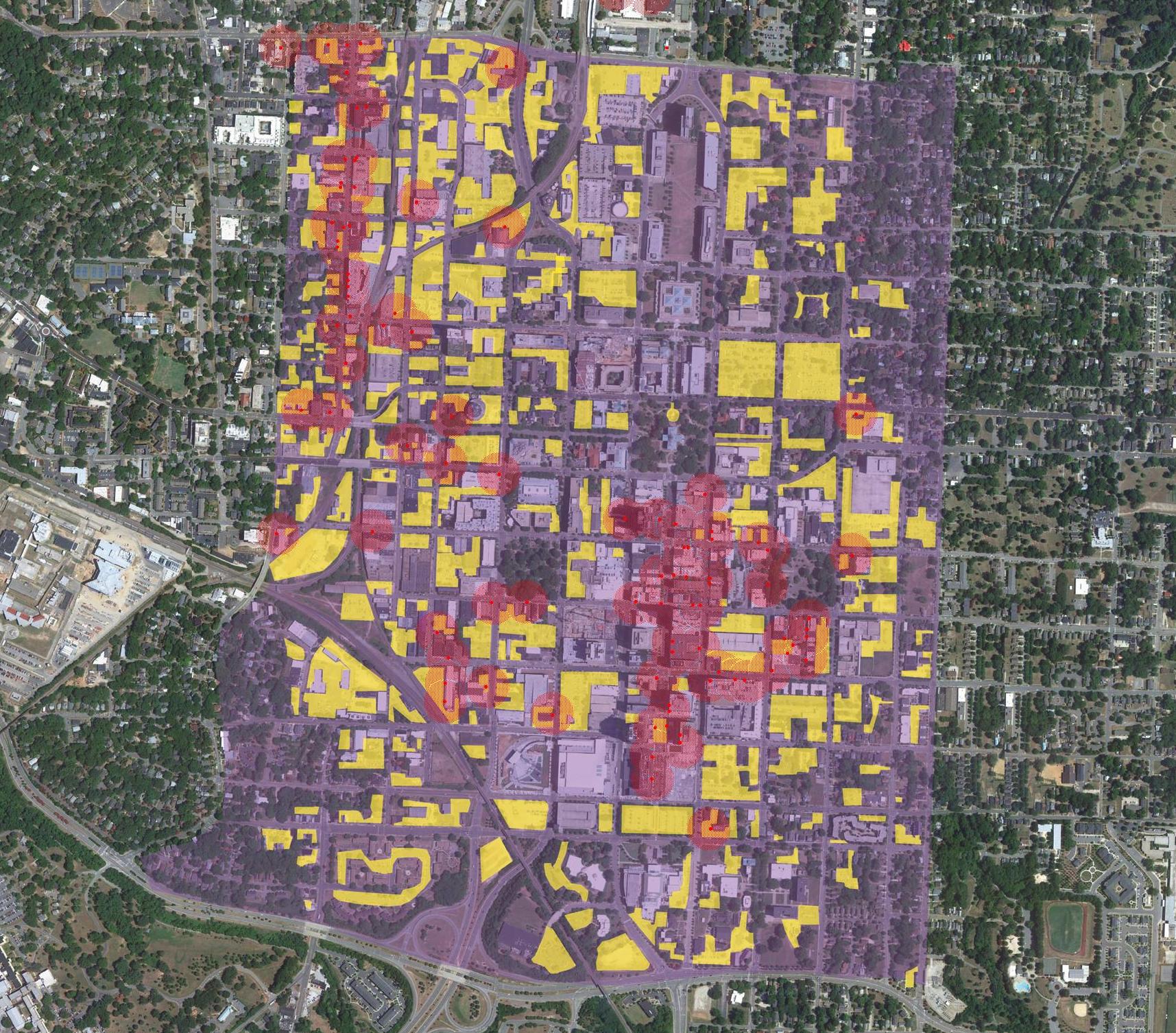
Map of downtown Raleigh with surface lots is an academic project created by the Downtown Living Advocates’ Streetscape Committee and Andrew Campbell of NC State.
Click the image for large or here for a full size.

In case you haven’t been following closely, the last time the food truck issue has been looked at by the city was at the Law and Public Safety Committee’s July 26th meeting. (meeting minutes here) No recommendation was made by that committee and it will next be discussed at their August 30th meeting. Once they make a recommendation it goes to the city council where they can approve it or pass it along for more review.

One of the restrictions that is being discussed is for the food trucks to be no less than 100 feet away from a restaurant’s front door. This restriction probably comes from a few restaurant owners that are against food trucks in downtown Raleigh. While I don’t agree with some of the arguments made by these owners, I feel there is a way to compromise in order for us to finally have the food trucks up and running.

I’ve modified a map of downtown Raleigh in an attempt to visualize what the 100 foot rule may look like. The map above shows a few things.

  • The purple area is Downtown Raleigh
  • The yellow areas show surface parking lots
  • The red areas represent where a food truck cannot operate under the 100 foot rule. These are 100 foot radius circles with the center being over a restaurant’s front door

The red areas’ locations are approximate and not every downtown restaurant is shown on the map, rather a majority is represented as I can still make my point with a few missing. Click on the image above to see a larger view or the link below it for a full size image for larger screens.

The Compromise

First off, I think the map is pretty powerful in showing the amount of surface parking we have in downtown Raleigh. I’d love to dive into this topic but I’m going to save it for another time. Instead, the point of overlaying the surface parking with the red circles shows us something else completely. There is a perfect opportunity, in my opinion, to have this food truck issue closed and all businesses can operate fairly.

The 100 foot rule is perfectly adequate to give the restaurants some breathing room from the trucks they are against. If you look at the map, the two sections of downtown with the most activity, Glenwood South and Fayetteville Street, are naturally buffered from any available spaces for food trucks to park. Restaurants claim it is unfair competition since they pay high rent and more overhead. The way I see it, those higher rents are getting these restaurants prime lots in downtown, which the food trucks can’t park in with this 100 foot rule.

With the map above, you can also see which areas have no food at all, mainly the government district north of the State Capitol. Food trucks can then provide a convenient service to a workforce that currently drives to get their lunches if they didn’t bring it with them.

The next issue that has been brought up is the affect of food trucks on traffic flow. The high amount of surface parking presents an opportunity for re-use and for us to energize these static, barren spaces. Food trucks can be kept off streets and parked on lots rather than in parallel parking spaces. They bring people to them and therefore the lots will have a new type of use by the pedestrian that it hasn’t had before. Collaboration between private lot owners, public lots and food trucks owners can work out a system, perhaps in the permit which they need to pay for anyway, so that certain spaces are designated for the trucks. Imagine private lot owners competing for food trucks to park in their lots because it gives them more exposure and more regular parking revenue from the trucks. It may just encourage some to clean up those desolate looking lots.

Some more official form of this map may end up being made by the city, as they are discussing perhaps raising the distance to 150 feet. According to the minutes of the July 26th Law and Public Safety meeting:

Chairman Baldwin asked:

7. What are the implications of an increase in the distance requirement from 100 to 150 feet?

Senior Planner Crane stated it is another 50 feet of distance. This was sorted out at the public hearing in April. He pointed out if you take this question with question #8 what are the implications of an increase in the distance requirement from residential areas to 200 feet? You will find along very narrow corridors like Glenwood South they will have a much smaller narrower area to locate these food trucks.

Assistant City Manger Howe stated they have not done enough specific analysis to see exactly how many spaces this may allow. It is possible to do this but would take some time. Ms. Baldwin asked how long it would take to do an analysis. Mr. Crane stated they would need a week to ten days. Mr. Howe stated they would still have to identify where the door is. A lot of the work can be done on GIS but you cannot tell on GIS where the door is. The group discussed this issue extensively as it relates to distance, mistakes that could be made, area sizes, doorway identification, industrial zoning, etc.

I haven’t seen this data yet so for now, we have the map that I put together in just twenty minutes. A more official map, I’m hoping, will help decision makers visualize the food trucks in downtown and help bring this case to a close. A compromise is all we need.
Municipography, Light Rail Moving Forward in Downtown Raleigh

Municipography is a summary of current issues going through the Raleigh City Council and other municipal departments in the city. The point is to try to deliver any video, photos, and text associated with the discussions happening at City Hall or elsewhere. Since this is a downtown Raleigh blog, the focus is on the center of the city.

Light Rail Alternative Discussion

The video above is not the entire Monday night public hearing but just the thoughts of each member of the council on the different light rail alternatives said at the end of the meeting. This was then followed by the council decision. Go here for the link to watch the meeting in its entirety.

Monday night’s public hearing about light rail in downtown Raleigh was short and sweet. Opening up the discussion was Triangle Transit with their pitch about light rail and the process they have been going through over the last few years. Next, the Passenger Rail Task Force (PRTF) presented their thoughts about their recommended light rail plan, the D6A plan, to the council and took their questions. Finally, members from the city staff presented their recommendations to the council, that being the D6 plan.

For some background reading, jump back to this post that talks about the two alternatives along with some good discussion afterwards from readers.

Very few citizens spoke after the presentations and afterwards each council member voiced their support for a light rail alternative, shown in the video above.

By a 6-2 vote, the D6 plan is now the city’s locally preferred alternative. The video ends with a nice quote from Mayor Meeker.

Let’s go ahead and get this system built as soon as we can.

Municipography, Food Trucks Debate Continues, Rezoning for Raleigh City Farm

Food Trucks

The food truck controversy continues with the Raleigh City Council passing the hot potato to the Law and Public Safety Committee for review. That committee’s next meeting is next week and their recommendation should go back to the city council for their meeting on August 2nd.

I felt like the tone of the meeting on this topic continues to be that of concern and fear. With the opportunity to create restrictions on this “nuisance”, the city council is clamping down on the food trucks without really thinking through it all.

The Law and Public Safety Committee is chaired by Mary-Ann Baldwin and also includes Councilors John Odom and Eugene Weeks. E-mail them your thoughts on the food trucks.

  • mary-ann.baldwin@raleighnc.gov
  • john.odom@raleighnc.gov
  • eugene.weeks@raleighnc.gov

Raleigh City Farm Rezoning

This rezoning request is for a property on East Franklin Street, here. Basically, it’s zoned for a shopping center and the rezoning is to remove any use of agricultural purposes on it. This is where the non-profit Raleigh City Farm wants to set up and the community seems to greatly support it.

The suggestion moves to the planning commission for review.

Municipography, Light Rail Through Downtown Raleigh

Recommendation from the Passenger Rail Task Force (PRTF)

From the agenda:

Triangle Transit Light Rail System

At their June 20, 2011 meeting, the Passenger Rail Task Force deliberated on alternatives for the proposed light rail system relative to downtown Raleigh. After discussing the item and reviewing data provided by City staff and by Triangle Transit, the Task Force voted 6-1 to recommend endorsing Alternate D6a, a hybrid alternative proposed by the Task Force during their deliberations. A complete explanation of the Task Force’s deliberations is included in the agenda packet.

Recommendation:
The City Council may wish to schedule a workshop to discuss the recommendations of the Passenger Rail Task Force in detail.

At the meeting yesterday, Will Allen of the Raleigh PRTF went through a brief presentation on the transit mode and route through downtown that they recommend. They agree with Triangle Transit’s preferred vehicle, that being “rail cars electrically powered by overhead wires”. Their route recommendation for the downtown Raleigh portion of the light rail piece is what they refer to as plan D6A.

Before we dive in, let’s be clear. This is a recommendation on Light Rail Transit, not high speed rail, whose drama series seems to be on hold for now. For a refresher on the latest light rail plans and where we last left this discussion, go ahead and jump back to March 2011’s “Light Rail in or over downtown Raleigh?

The post back in March talks about a few plans that were on the table for light rail through downtown. The D6A plan, the one recommended by the PRTF, was only mentioned lightly at the transit meetings that took place earlier this year. If you watch the video, the presentation recommends this plan:

The PRTF belives the D6a route through downtown Raleigh will best serve Raleigh citizens for the present and future by providing the best oppurtunities for ridership and economic development while ensuring safe transportation and minimizing impacts to traffic, urban design, noise, contextual planning, historic resources, and long term options for roadway and to connectivity improvements, all at a reasonable cost compared to other alternatives.


View D6A in a larger map

I threw together this Google map to show the proposed D6A route. In addition to recommending D6A, the PRTF also recommended the already talked about D6 plan but only if D6A was seen as too impractical.

Triangle Transit likes D6. The City of Raleigh likes D6 as well.

I did some searching and found this little gem of a pdf. “Memorandum: Issues Regarding Proposed Light Rail Alternatives in Downtown Raleigh” dated June 30, 2011. Eric Lamb, Manager of the Office of Transportation Planning sent this to our city manager, Russell Allen, and other interested peoples.

You can read as much or as little as you like but here are some highlights which I’ll quote.

Overview & Alternatives
….
There are several alternatives that TTA has presented to the task force and to the public with multiple options for traversing downtown. As a result of their deliberations, the task force chose to develop a hybrid alternative called D6A that was not previously considered or studied by TTA.”

D6A is introduced and described in text and hard to read black and white maps.

Value Capture & Redevelopment
….
The majority of land along the Salisbury/Wilmington corridor north of Union Square is owned and controlled by the State of North Carolina. It is unknown as to whether or not consideration of Alternatives D5 or D6A would induce the State to divest itself of these properties for the purposes of re-development.

An issue seen with running light rail through the government district is that it won’t encourage redevelopment because it is state owned land. Development from light rail is needed, to an extent, to help pay for the system.

Dawson/McDowell Corridor Conflicts
….
Triangle Transit anticipates operating train sets composed of up to three 90-foot vehicles, making each train set a maximum of 270 feet in length. An Average city block in downtown Raleigh is approximately 400 feet long. It is also anticipated that operating this system streetcar-style will occur in mixed traffic, i.e. it will not be within a dedicated lane exclusively for transit use. If queues or more than four to five passenger cars already exist for eastbound or westbound traffic at either Dawson or McDowell Streets, an approaching train would queue across the previous intersection while waiting for the traffic signal.

Basically, NCDOT is worried that the back end of a train will stretch into it’s US 70/401 corridors and block traffic. At peak hours, almost every 10 minutes you’ll have a train cross a road that sees between 40,000 and 50,000 vehicles.

Impacts to On Street Parking
….
Please note that another major obstacle to removing on-street parking may occur adjacent to the North Carolina General Assembly (NCGA). In 1998 the NCGA took control of these streets for the purpose of establishing exclusive use of on street parking for legislators and their staffs (see NCGS 120-32.1). Operating a light rail system along Salisbury and Wilmington may require the removal of this reserved parking and will ultimately require the permission of the Legislature as an encroachment on the legislative grounds.

Pretty self explanatory here. I’d love to sit it on this meeting if the city goes this route.

Cost Estimates

A summary of the system costs for each alternative is included below. Please note that TTA has not conducted any analysis of Alternate D6A and the cost estimates for this alternate have been extrapolated from costs for D5 and D6.

Table 2

I’m unable to properly copy Table 2 so I’l put it in list form below. Costs are in M, for Millions, B for Billions:

  • D2, Downtown segment cost $270M, total system cost $1.425B
  • D5, Downtown segment cost $435M, total system cost $1.590B
  • D6, Downtown segment cost $265M, total system cost $1.420B
  • D6A, Downtown segment cost $330-350M, total system cost $1.485-1.505B

Summary
….
The staff’s perspective is that this position does not appear to be directly supported by the data. Our analysis of existing and extrapolated data concludes that the hybrid Alternate D6A will likely cost more, will operate less efficiently, has potentially greater historic property impacts, and may not generate sufficiently higher ridership to warrant further consideration.

Well there it is. Lamb does recognize that the D2 and D6 alternates also have their own problems but claims they “appear to have fewer hurdles than Alternate D6A.”

As stated in the summary, the PRTF looked more at the “what” during their analysis where the city focused on the “how”. Any readers that are focused on the “when” may have to cheer on our neighbors in Durham County this fall.

Municipography, Transit, UDO, and Historic Districts

Transportation bond increase from $37 million to $40 million, includes Union Station

Transportation Bond
During the June 7, 2011, City Council meeting it was directed that an item be placed on this agenda to consider adding $3 million to the proposed transportation bond for the Union Station/Train Station proposal.

Overview of the comments submitted for the Unified Development Ordinance (UDO)

The Unified Development Ordinance (UDO) Advisory Group Report
The Unified Development Ordinance (UDO) Advisory Group will provide a report to the City Council on their final review and assessment of the Unified Development Ordinance April 6, 2011, Public Review Draft.

Recommendation:
Receive the Advisory Group’s final review and assessment for purposes of authorizing an official public hearing date for the proposed Unified Development Ordinance.

2. Summary of the Unified Development Ordinance Public Comment Period
Staff will provide a report on the comments received from the public comment period (April 6 – June 6) of the Unified Development Ordinance April 6, 2011, Public Review Draft.

Recommendation:
Assess staff’s report on the UDO public comments for purposes of authorizing an official public hearing date for the proposed Unified Development Ordinance.

There were lots of comments submitted and the video goes over some of the comments received. More time was asked to go over this feedback as well as to continue formulating the UDO before bringing it to a public hearing. We’re certainly not near the end of this UDO process as the hearings will most likely take place at the end of this year or early 2012. The Raleigh Public Record has this all nicely covered.

South Person/South Blount Historic Overlay District Proposal

As follow up to a 2000 City-initiated small area plan, the Raleigh Historic Districts Commission (RHDC) will present the Report and Recommendation for the Designation of the South Person/South Blount Historic Overlay District, based on feedback received from property owners within the proposed boundaries in response to both mailings and RHDC-sponsored community meetings.

Recommendation:
Receive as information the Report and Recommendation for the Designation of the South Person/South Blount Historic Overlay District, and refer the report and recommendation to the Department of Cultural Resources, the South Park-East Raleigh Neighborhood Association (SPERNA), and the Downtown Raleigh Alliance (DRA) for analysis and recommendation.

Raleigh’s Creative District

By split vote, the Committee recommends approval of the project titled “Amplifying Southwest Raleigh Through Branding and Economic Development Strategies” with the understanding that the City Council will receive periodic reports on the project.

Municipography, The City Budget and The Arts

Municipography is a summary of current issues going through the Raleigh City Council and other municipal departments in the city. The point is to try to deliver any video, photos, and text associated with the discussions happening at City Hall or elsewhere. Since this is a downtown Raleigh blog, the focus is on the center of the city.

The agenda during the City Council meeting yesterday, June 7th, 2011, did not involve many downtown topics directly. The Raleigh Furniture building, at 119 East Hargett Street is up for consideration as a historic landmark. This issue moves to the Raleigh Historic Districts Commissions and will report back on June 21st.

The excitement during yesterday’s meeting were the many comments on the 2011-2012 proposed budget. Watch or listen to the video below to get an idea of what citizens had to say.

Comments About The Budget

The comments about the budget went long during the evening session of the council meeting and arts funding opened it up. After some brief words from a few members of the community, the show of support was strong when a large group of arts supporters stood up and left together, bringing the meeting to a short stop before moving onto the next comments. There is no doubt that the arts are important to downtown Raleigh so this line item on the budget should be tracked closely.

2011 Top Places of Empty Spaces, Filling Retail Space In Downtown

Some have heard it, others say it. “We need more retail.” And then there are some who make the suggestion that downtown needs more space for this sought after retail. Do we need more space for retail in downtown Raleigh?

Long time readers of RalCon may remember older posts where I went over some of the most important spaces that, at the time, were left vacant. For some background reading make sure to jump here:

Top 10 Empty Spaces To Fill Around Downtown (September 19, 2008)
Follow Up, Top Ten Empty Spaces to Fill Around Downtown (September 28, 2009)

It has been well over a year since the last post on this topic so I thought I would take us through again. Rather than naming and ranking the places, let’s just start with different districts and discuss their evolution over the past few years.

Seaboard Station

I had to investigate this one because of the recent chatter in the comments about the upcoming renovation to 111 Seaboard. Outside of that renovation, there are two main empty spaces amongst the warehouses that make up Seaboard Station.

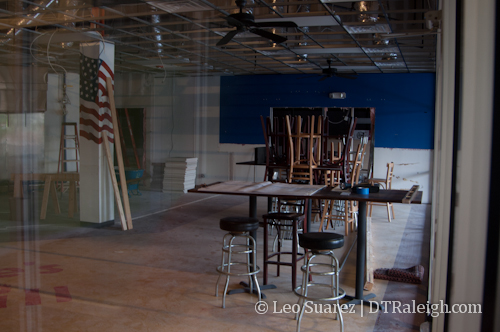
Rumor has it that Tyler’s Taproom will set up in the old Tookie’s Grill space near 18 Seaboard. Walking up to it, Tookie’s has been pretty much gutted. What is interesting is that a hole in the wall has been made opening it up to the space next door and adding what could be a large restaurant area. The Tookie’s space could hold a bar with a bunch of TV’s and the larger space next to it could be the restaurant area with larger tables. Outdoor seating may be tricky though as there isn’t much room outside the doors. Either way, this seems to be the likely candidate for a Tyler’s type bar/restaurant.

The other space near the rear of Seaboard Station, near Peace China, has been subdivided into, what looks like, offices. From the work that has been done, there is little indication that a restaurant will go in. It’s tough to think that Tyler’s would go here after seeing the Tookie’s space in its current state.

There is your update as of today. Let’s hope for some good news in the near future.

Glenwood South

Glenwood South has been running near capacity from what I have seen. A couple places have changed in the past year or two though, The Rockford has changed owners, Ivy has closed and is now being renovated, The Artisan is now where Sauced Pizza used to be, and a few other minor tweaks.

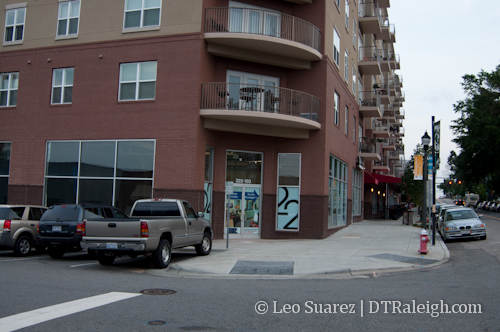
The most important space that is empty or being worked on in Glenwood South, in my opinion, is the corner space of 222 Glenwood. This huge space could hold a landmark restaurant that shows off its activity through the huge windows that face the street. The corner entrance could really make it a statement to pedestrians and drivers coming up Glenwood. This space has never had an occupant.


I’d like to see outdoor seating instead of parking spaces on the side street but I’m just nit picking.

The rest of the building is pretty much occupied, with signs up now for the upcoming Tutti Fruiti and Zaky, we could be weeks or a few months away from an opening.

The Warehouse District

The Warehouse District is on the rise thanks to the injection of activity brought on by Contemporary Art Museum.

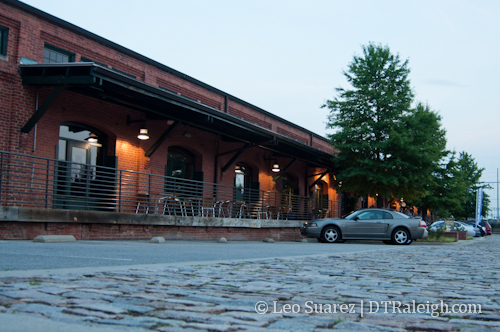
The Depot building is more stable then it has ever been in the last few years with Jibarra leading the way. Tuscan Blu has opened this year and a beer bar, The Union, anchors the historic building toward the back. The upcoming Tasty Beverage Company store will open this year leaving the prime Davie Street space looking for a tenant.

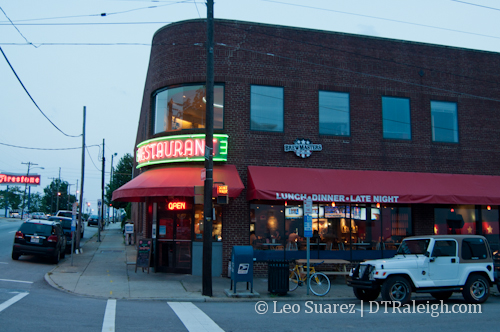
Martin Street is on the rise as well. Raleigh Denim has moved into Commerce Place and Brewmaster’s has filled the old Joe’s place on the corner of Dawson Street. You’ll see more art in the area because of the new museum and the relocation of the Visual Art Exchange nearby.

Over on Hargett Street, The Hue could use a little love. There still is some empty space on the ground floor but it has improved slightly. A real estate agent is renting space and there is work being done on Astoria Cafe. There is still plenty of space and hopefully it gets filled as more renters move into the building.

Fayetteville Street

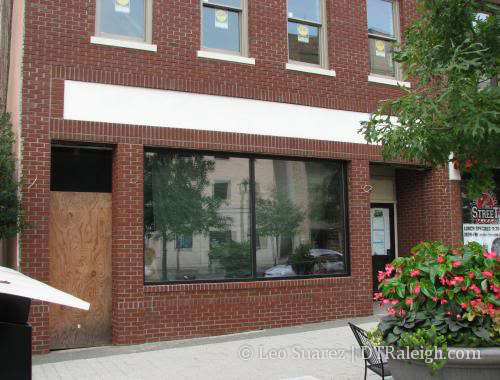
There’s a lot to cover on Fayetteville Street so let’s start with what was highlighted in the past posts. The following spaces are still empty:

  • 114 Fayetteville Street, next to Isaac Hunter’s
  • Odd Fellows, corner of Hargett and Salisbury
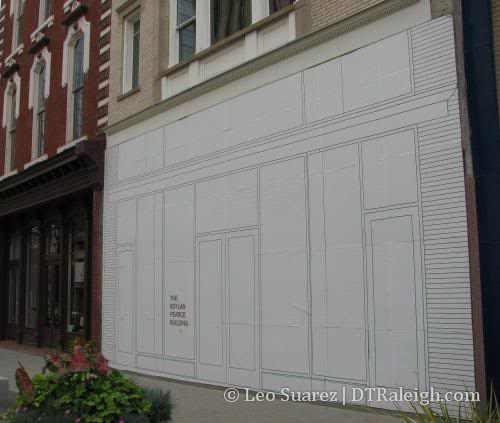
  • Boylan Pearce Building
  • Spaces along 100 block of East Hargett Street


This picture from 2008 still applies.


So does this one.

So there are still some holes to fill along North Carolina’s Main street and the side streets but there is some positive news here.

Finally, one of the ground floor spaces of the RBC tower will be filled. A Pan-Asian restaurant from the owners of Sono and The Oxford are working on something new in this space. The tower still has two other retail spaces that are empty but walking along Fayetteville Street will be complete on this block once the new place opens up.

Ashley Christensen will be bringing three new establishments to the corner of Martin and Wilmington Street. We highlighted this building on one of the older posts on the blog so we can now take it off the list. From the article,

She plans to open three new eateries – a burger joint, a fried chicken and honey place and an underground bar – in a 4,000-square-foot-space in downtown Raleigh in late spring. She says the food will be “simple but with a lot of energy going into the details.”

I had some good times a few years back at Alibi Bar but I’m not sure it competes with it’s successor, Neptune’s Parlour. Pair it with King’s in the upstairs space and you have a killer combination. The ground floor space that used to be Martin Street Pizza will be a restaurant in the future, rounding out the trio of offerings at 14 West Martin Street.

City Market

What I think is the grand daddy of downtown, The City Market building, is sort of half full. Still.

Half of the historic market building is being used as event space while the half facing Martin Street, the one I call the front, sits vacant. Cobblestone Hall is used for weddings, receptions, parties, anything really. They play on the historic charm theme with City Market’s cobblestone streets.

It has been years since the fire at Greenshield’s which used to be in the building. Does anyone have the year by the way? Still, I think City Market is being held for something grand, something that really is a regional draw and a landmark institution for downtown.

The conversation here is really just a subset of new openings, closings, and empty spaces around downtown.

Fayetteville Street Post Office Closing, Lost Service or New Opportunity?

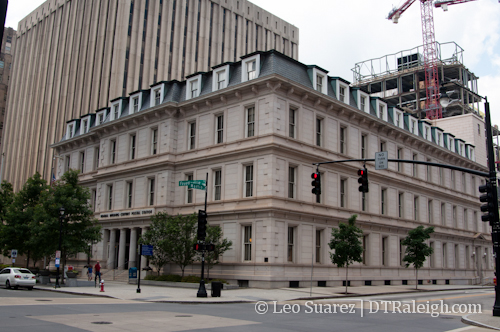
The post office on Fayetteville Street will close this July according to the N&O.

Citing drastic declines in mail volume, the U.S. Postal Service will close its downtown post office in July, shuttering an institution that has stood on Fayetteville Street for 134 years.
…….
There was no word about a possible future use for the ground floor space that will be vacated. Post office officials did not return calls seeking comment, but a note taped to a mail slot attributed the closing to recession-related declines and changing consumer habits.

No one should be surprised by this news as multiple offices have been closing around Raleigh and around the country. The U.S. Postal Service can’t seem to cover their costs so it is only natural that closings like this are occurring. The state of the current economy also doesn’t help things out.

I actually first heard about this news on Twitter. The tweets I read were from people asking others to support the office and demand that it be left open. I do understand that the service is still needed, even relied upon by some but I can’t seem to get behind the idea of keeping the downtown office open.

Am I against the mail service? Not at all. I feel that this service should continue to exist for all citizens but in today’s shift from paper to internet, the service should transform with the times in an appropriate way. This shift is not what this post is about so I’ll stop with that statement in order to stay on topic.

Anyway, the historic, beautiful building on the corner of Martin and Fayetteville Street will have some open space soon and I believe this creates an opportunity for something new. My first idea that I have had for a little while (PROOF!) is for the Century Post Office to be repurposed into a library. Maybe not right away, or perhaps not the first use of the new space but with a growing downtown this would be a perfect opportunity to have a downtown library in a landmark building with a prime address.

The federal government’s current cutting of excess properties makes this an interesting opportunity for, perhaps, Wake County to make a play at moving into the building.

Downtown probably still has a long way to go before the downtown express library is upgraded but you never know.

The postal service may be moving out but the building will still stand and can serve citizens in a new way in the future.