Fareless Transit Ideas

Here’s an interesting read that I’d like to highlight. Aaron Renn’s blog, The Urbanophile, suggests an interesting concept for smaller cities that are trying to grow transit. Make them free. Well not exactly free but without fares. Renn states:

Why have a fare in the first place? It is odd that we pay per use on transit. We don’t pay to check books out of a library. We don’t pay to visit most city parks. We don’t pay when the police or fire department come to our house for a legitimate emergency. Most non-utility municipal services are provided for free to users and funded by taxes. So why is transit different? I suspect it is rooted in the origins of public transit systems when they were private, for-profit companies. But they aren’t that today so why adopt those legacy practices?

Read the rest of his post for some solid ideas supporting the use of fareless transit.

There’s actually nothing too radical suggested here as Chapel Hill has been fare-free for over eight years as well as downtown’s R-Line. This may or may not be something to consider as the transit section of the 2030 comprehensive plan is concerned.

Tracking Buses Online and On Your Phone

Recently, the city has created some online and mobile tracking services for the buses in Capital Area Transit. The best part is that they all have maps associated with them. I love me some maps.

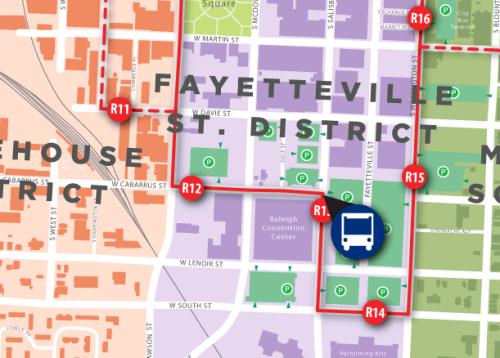
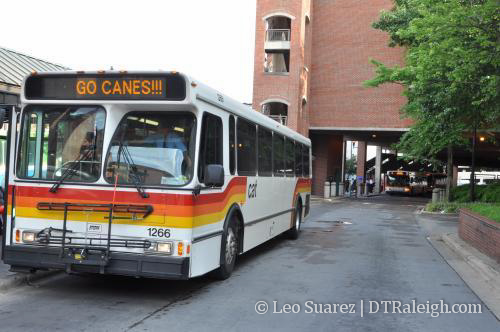
For downtown, this includes the R-Line, which is technically part of CAT and is shown on the CAT tracking page. The Downtown Raleigh Alliance (DRA) tracks the R-Line on their page as well. Below is the link rundown so update your bookmarks.

DRA live map
www.godowntownraleigh.com/get-around/r-line/status

DRA live map mobile version
m.yourhere.com/rline-map.php

CAT Bus tracking
raleighrides.org/

NCSU Wolfline Tracking
ncsu.transloc.com/

I’m mentioning the Wolfline tracking system because it has been around for years and is still the better service of the few, in my opinion. Take a look at it to see what all the services should work towards becoming one day.

The R-Line mobile site is easy and straight to the point. If you have a smartphone, you can pull up the maps with the location of the buses pinpointed on the route in real time. The bus stops are marked by their appropriate names so finding where you are on the map is easy once you are at an R-Line stop. Streets and their names are also displayed so the map now becomes a personal guide to navigating downtown on your phone. It’s a great start for making the experience of riding a bus slightly easier and puts a system in place that can be easily updated and scaled out as transit in Raleigh grows.

$545 Million For Rail Upgrade From Slow To Mediocre-Speed

The point of this post is not to sound pessimistic but I need to get one thing off my chest first. High speed rail does not consist of trains moving at 110 mph. That is not at all pushing the limits of what modern day trains can do. I’m sure it sounds fast but when North Carolina has trains zipping from one side of the state to the other at speeds of 200+ mph, then we can throw around the term ‘high-speed’. If you want an idea of what real high-speed looks like click and watch this video.

With that out of the way, our state is getting $545 million of federal stimulus money that will go towards improving rail transit. The bulk of the grant, $520 million, will go towards the Charlotte to Raleigh corridor with the rest being spent on the connection north to Richmond. This was part of $8 billion worth of stimulus funds being allocated between 33 states. Click here to see the entire list of states and who got what.

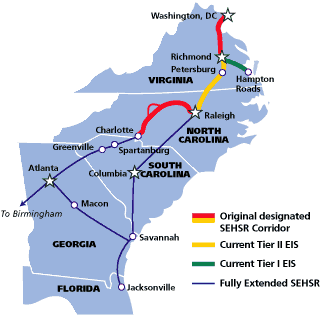
Its called the Southeast High-Speed Rail corridor that may one day connect Washington DC to Raleigh and Raleigh to Charlotte and on to Atlanta. We’ve talked about this before on the blog. Along with our ‘winnings’, Florida was the only other southeast state that received money however. Because it’s part of SEHSR, tracks will be improved to increase speeds and the frequency of trips between the queen city and the capital are planned to double.

I have not quite gotten around to doing the train trip to Charlotte but it is on the to-do list. Let’s see what the experience would be like if I left this weekend.

  • Booking a trip on Amtrak.com seems easy enough. Leave Friday, Jan. 29th and return Jan. 31st.
  • The Piedmont leaves at 6:50am for $25. I need to work so I’ll pass
  • The Carolinian leaves at 4:50pm for $25. My only other choice so I’ll go with this one.
  • I need a return trip. I again have a morning and afternoon option. The Piedmont it is at 5:30pm for another $25.
  • Total travel time: 3 hr, 24 min departure. 3 hr, 13 min return. $50 total cost

We’ll re-visit this post later in time to compare if things are getting better. Now I love riding a train but it also has to make sense. This might work when compared to a single person driving to Charlotte but if I bring the lady with me, splitting gas beats this situation every time. In this scenario, the cost is what is driving people away and so is the ease of a major highway connecting the two cities.

I’m hopeful though, as always, and think that the faster trains would make them competitive with the highway. If driving and riding took the same amount of time, the convenience of sitting in a spacious rail car and never being slowed by traffic might be worth it to some people.

As for downtown Raleigh, this corridor would go right through it and more passengers means much more headaches at an already too small train station on Cabarrus Street. The additional trains and passengers may help get us talking about that multi-modal transit center for the Boylan Wye.

Also, the Southeast High-Speed Rail project has a great website.
How Free Is That Parking Outside of Downtown?

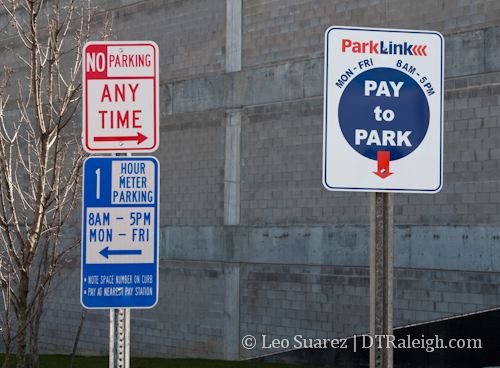
I thought this video was very interesting and brings up some great points. Although cities in New Zealand are used as examples the exact same principles apply right here. Soon, downtown Raleigh will install pay stations for on-street parking that has, mostly, been free for decades. What is not being talked about are the plans to lower or eliminate the minimum parking requirements (MPR) in downtown.

The video suggests that paying to park is like paying for what you use rather then buying goods at prices that factor in the cost of the MPR. In theory, eliminating MPR should lower prices and give the consumer more of a choice. That choice being to pay to park or use another mode of travel to avoid paying. The cost to provide that parking is not passed on to the consumer where it is in the “free” parking lots of the suburbs.

Interesting stuff!

City of Raleigh | More Than 150,000 Passengers Ride Downtown Raleigh’s R-Line

A total of 152,634 passengers rode the R-Line from Feb. 13, its first day of service, to Dec. 5, according to a report on the latest ridership totals. The report also found that during this time:

  • An average of 519 passengers rode the R-Line daily, including weekends;
  • The bus carried an average total of 535 riders each weekday;
  • An average of 719 commuters rode the R-Line on Saturdays; and,
  • The R-Line’s average passenger count on Sundays was 241.

via City of Raleigh | More Than 150,000 Passengers Ride Downtown Raleigh’s R-Line.

Try Transit, Win Prizes

This week is Try Transit Week. Jump into the event website or read the cliffnotes below:

Try Transit Week is an annual campaign sponsored by Durham Area Transit Authority (DATA), Cary Transit (C-Tran), Capital Area Transit (CAT), NCSU Wolfline and Triangle Transit. The goal of the campaign is to encourage Triangle Commuters to try an alternative mode of transportation in an effort to help save our environment, reduce the stress of traffic congestion and save money on expensive gas prices.

This year, each of the sponsors is hosting events across the Triangle area including a Fare FREE Day, a “Stuff the Bus” food drive and various give-aways to show appreciation to our bus riders and operators.

If you are on Twitter, you should be following these accounts

Go here is you want to participate in the scavenger hunt and win free stuff.