Parking Meters For An Improved Pedestrian Experience

This is the last week to vote in our October Poll about the upcoming parking meters in downtown. Cast your vote in the poll located in the sidebar of the blog.

Parking always seems to be a huge complaint for a number of people who visit downtown Raleigh. I’ve become very interested in the city’s push for new parking meters in select downtown areas. I’ve become even more interested in the reactions out of citizens and how it may change their behavior or view of downtown. Is the city trying to squeeze more money out of current visitors or is the city trying to help boost its economy? Opinions are all over the place on this so I’d like to talk about a few ideas in favor of the parking meters. However, my opinion could change based on how the city plans to use this new revenue stream and what programs they put it toward. In my opinion, I feel that the parking meter revenue, after maintaining itself, should be put back into the sidewalks of downtown Raleigh.

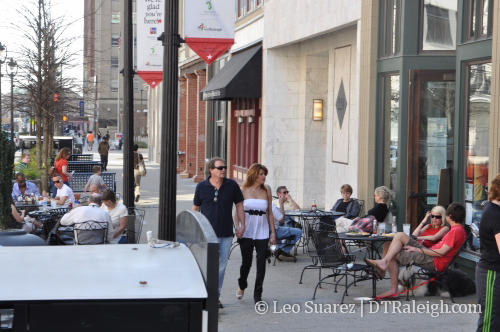
The most used transportation option in downtown Raleigh are the sidewalks. Tens of thousands of people walk on them every day; along Fayetteville Street and from Moore Square to Nash Square. To encourage more foot traffic, attractive sidewalks should be built and maintained in order to encourage businesses to open along the sidewalks where people are walking. If the money from the parking meters were put into creating attractive sidewalks, the business community will take notice. The money should be used to repair cracks, clean the area, plant trees, install bike racks, paint light posts, install attractive lighting, etc. Improving the pedestrian experience will keep people walking around and browsing the many shops and restaurants that downtown has to offer. Fayetteville Street is nice but I’m sure all of you can name a couple of sidewalks that desperately need repair and therefore have no shops near them.

If the city made plans to improve the sidewalks using the parking meter revenue then this strategy would be supported by the business community and the general public. Seeing the money being spent in the sidewalks would please a lot of people because it can easily be tracked. Internet commenters are notorious for accusing the city of keeping similar revenue in a vault somewhere in city hall. All kidding aside, people will support the parking meters more if results are in plain sight, not if the money is spread out between many other public services.

Also, if there were no visual improvements in downtown, then recruiting businesses to sign leases on our numerous empty retail spaces would be even more difficult. This may be the reason that downtown Raleigh lacks a decent supply of outdoor seating or really anything more then just a bunch of tables on the sidewalks. Sidewalks that are clean, maintained, and have an established flow of cash for improvements will tempt developers to invest more in their building and business owners to raise the bar, knowing that their “front lawn” is taken care of.

The end goal is to improve the pedestrian experience in downtown Raleigh. Fayetteville Street had a makeover a few years ago and still looks great. However, the metered zone is well outside the main street and improvements should occur along those sidewalks as well.
Fayetteville Street Art Renaissance?

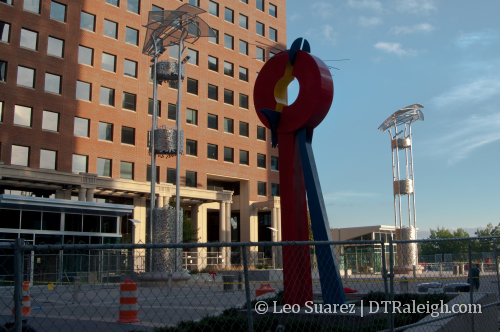
The News & Observer has an article describing the the new art pieces coming to City Plaza and the ones that will be on display for Raleigh Wide Open 4 this Saturday. Craig Jarvis writes:

The most significant additions will be the unveiling of two new pieces of interactive art and the launching of three new sculptures in City Plaza, all along Fayetteville Street. In addition, a gallery will open in one of the four new pavilions in the new plaza and the latest round of art on the sides of city buses will be exhibited.

If you have been following the Fayetteville Street renaissance throughout the last couple of years, you may have noticed that public art for the street has been proposed a few times, each bringing with it its own drama and controversy.

In 2006, “chandeliers” were proposed for the street but were never approved because of a lack of community acceptance. The vista between the Capitol and the Performing Arts Center was seen as too grand to intrude on and talk of Las Vegas style lighting was frowned upon by the community. The privately funded chandeliers were voted down.

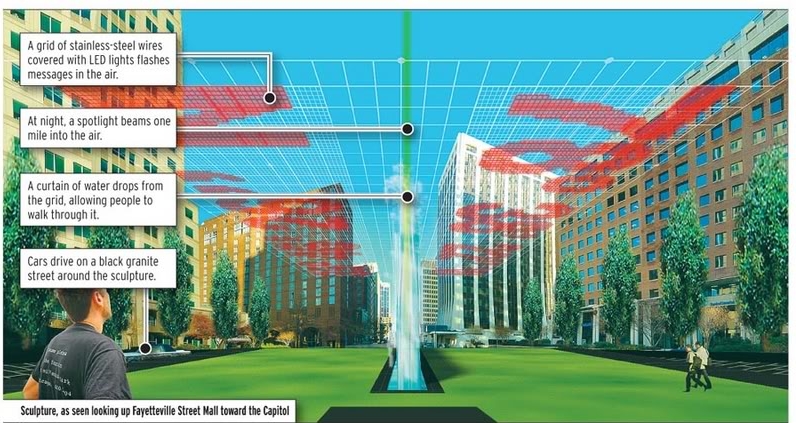
That same year, the Raleigh arts community was deep in another controversy, the Jaume Plensa Plaza proposal for the space that is City Plaza today. In early 2006, reports of his hiring to design a public plaza here in Raleigh were circulating. His design, shown below, for the space was bright with LED lights, moving with a wall of water, and open with a grassy field. Again, the grand vista of Fayetteville Street took priority and after the city council paid to create a mock up to see it for themselves, the project still was not going anywhere. Finally, the generous donation by Jim Goodmon of $2.5 million was pulled and that was the end of that. Read this article for a nice wrapup of the “fiasco”.


Click for larger, via newsobserver.com

Was Raleigh lacking vision in these two situations or does public art not have the support of citizens and therefore turned down because of that non-acceptance? Lots of private funds were being collected for these pieces so use of tax money could not have been the issue here. I’ll admit, I was a huge fan of the Plensa Plaza in its early days but looking back that was only because I supported something new for Raleigh from someone with a big name. But should we really just approve everything that is proposed without taking careful consideration of it? Lots of commenters on this blog say that they are tired of the city council approving every “weak” development project that is presented to them. In my opinion, I now support the the current City Plaza design better then the Plensa Plaza. (even if Jim Goodmon thinks I’m stupid, video below) We all have our different opinions and I respect those that have a valid argument, for or against mine.

The art on City Plaza is a step up from what we had before on Fayetteville Street and the discussion on the “lost opportunity” of the chandeliers and Plensa Plaza could go on forever. Check out the art installations after the grand opening this weekend and make up your own mind.


Durham’s unveiling of Plensa’s light tower for the Durham Performing Arts Center (DPAC) via GinnySkal

Suds and Speculation, October 2009

I was having a conversation two nights ago with a good friend while admiring the view from the patio at the Boylan Bridge Brewpub. Most of it was about downtown and what we “needed”. While drinking some beer, we painted a picture of Raleigh in the future. I, like most, seem to get carried away with grand plans for the city that realistically will take decades to be seen. I always have to drag myself back to earth, however, and when I do, I focus on the near future. I think about the kind of things we can start today or can change in 12, 18, or 24 months from today.

Ever since I got into this whole downtown Raleigh thing, one of my top online sources for information was the city’s Livable Streets site. A key page I would like those interested to see is the Five in 5 Strategy. Even though there are about 130 strategies to the Livable Streets plan, these five:

were chosen because of their ability to be a catalyst for others, to build momentum and to excite all members of the community. One or more of the Livable Streets Partners has agreed to accept responsibility for each of the five. Each has already begun moving toward completion. As one is finished, others will be undertaken until we have the vibrant, active and livable streets that we all desire.

Does City Plaza mark the end of the revitalization of downtown? I certainly do not think we have achieved livable streets in Raleigh. The idea also should not be limited to this area as the rest of the city should have elements of what livable streets are. The Livable Streets website states:

We believe that people make a city great. Yet, so many of the world’s great cities dedicate too much of their precious, limited public space – their streets – to motor vehicles rather than people. We are working to redesign our communities around public transportation and walkable, bikeable streets. We are transforming parking lots into public plazas, busy intersections into town squares, and congested highways into bike paths.


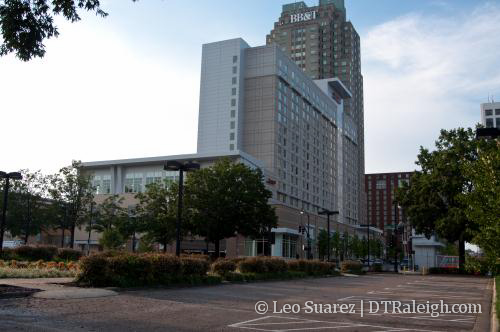
What is urban about a surface parking lot a block away from our second tallest building?

The Five in 5 strategy lists:

  1. Complete a Fayetteville Street Renaissance
  2. Fund and build a new convention center and hotel
  3. Improve the pedestrian environment
  4. Undertake regulatory reform
  5. Expand downtown management

The Fayetteville Street renaissance will be complete with Raleigh Wide Open 4 on October 24th and the opening of City Plaza. If you read this blog, I should not have to prove to you that point number 2 has been complete for over a year now. The next three tasks, I believe, need to work together in order to achieve true livable streets.

City Plaza is a good start to a better pedestrian experience in downtown. The area will have wide, safe sidewalks and approachable retail spaces for people on foot, bikes, rickshaws, anything other then a car. Cars cannot park in the area and can drive through only. The curbless “road” is flush with the sidewalks which will naturally calm traffic down and force drivers to look out for those walking by. I see it as a major sense of place and possibly the most urban block in Raleigh.

The livable streets mentality must emanate from here and throughout the downtown streets. Roads should be made bike friendly and riding should be encouraged, for example with more bike racks, discussed in a post one year ago here. (coincidence, I sware) There should be well paved sidewalks from all the neighborhoods around downtown that make it easy for people to cross streets.

I honestly could go on for hours on this topic but I’m sure most of you have heard most of this fluff about transit and biking and blah blah blah already. The thing is, I believe it is important to keep bringing it up in order to get more people behind it and to make sure our city leaders continue to stick to these values. If you want that dense, tall tower or that twenty-four hour diner or lots of shopping in downtown, it starts with getting people to live their lives in and around the area, OUTSIDE of their cars.


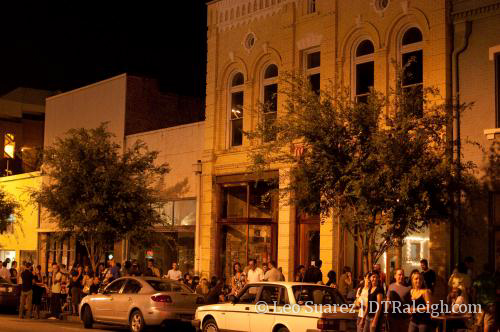
Lots of life on the sidewalks outside of Raleigh Times.

Follow Up, Top Ten Empty Spaces to Fill Around Downtown

I may turn this post into a yearly thing so that we can follow the retail scene in downtown Raleigh. About a year ago, I posted a list of ten empty spaces that should be filled with retail or office space or something. In my opinion, they were the top ten spaces that get a lot of exposure and should be contributing to the downtown sidewalk culture. Now, we can take a look at the progress and see what else has changed in a years time.

The 2008 top ten list:

  1. Progress Energy II
  2. Wilmington and Martin Street
  3. 14 West Martin Street
  4. 114 Fayetteville Street
  5. The Raleigh Sandwich Shop
  6. Odd Fellows
  7. Commerce Place
  8. Boylan Pearce
  9. The Depot
  10. City Market

Unfortunately, there is not much to report. The current state of this list is very similar to the state it was in about a year ago. The old Music Hall at 14 West Martin street now has Club Fourteen and the City Market building has on-going construction work in the half facing Martin Street while the back half sits empty. Jibarra has opened in The Depot space but the rest of the building still sits empty. The emptiness at 114 Fayetteville has spread next door with the closing of the Fayetteville Street Tavern.

New Additions:

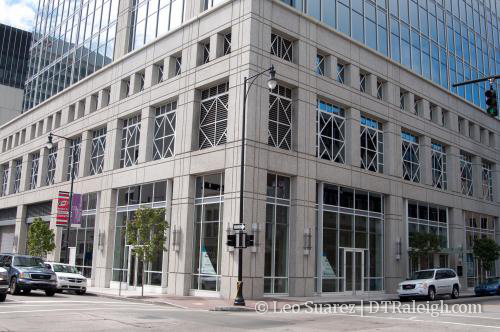
  • RBC Plaza – This tower offers three retail spaces to the core of downtown. Unfortunately, they have been empty for almost a year.
  • Hargett Street – The intersection of Hargett and Wilmington streets has become one of downtown’s busiest and the empty spaces along the 100 block of East Hargett street is missing out on the action.
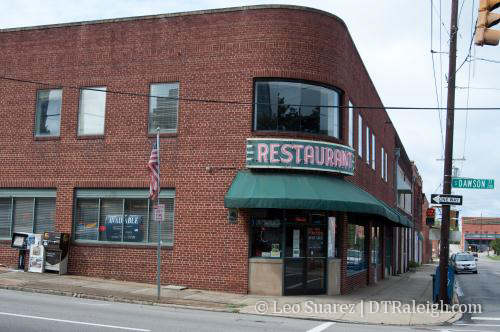
  • The Hue – The condos are for sale and so is the empty retail space along Dawson and Hargett.
  • Joe’s Place – Who will add more neon to the now closed Joe’s Place at 301 Martin Street?

Council adopts new vision for city’s growth – Local & State – News & Observer

The City Council voted unanimously today to adopt a new long-term planning document that will shape future development in Raleigh for the next two decades.

The vote means that the document, called the 2030 Comprehensive Plan, will officially go into effect Nov 1.

via Council adopts new vision for city’s growth – Local & State – News & Observer.

Dense Downtown Neighborhoods

It does not take a scientist, or some fanboy blogger, to tell you that more people are spending time downtown. Overall, more restaurants are opening up and being patronized by people outside of the nine to five work week hours. It still takes a major event to bring more people downtown on a weekend day then a weekday but the once sleepy ghost town has recently found new life. Visitors are on the rise because of the options on nights and weekends and the amount of downtown residents have slowly risen as well. I’ve always thought that downtown is at an interesting point with new businesses and new residents. New places may not open because of the lack of residents living close by. At the same time, people may not want to move downtown because of the lack of available shops and convenience stores. Slowly, downtown Raleigh will break this cycle when it reaches a certain amount of residential density and I see potential in Dawson St. leading the way.

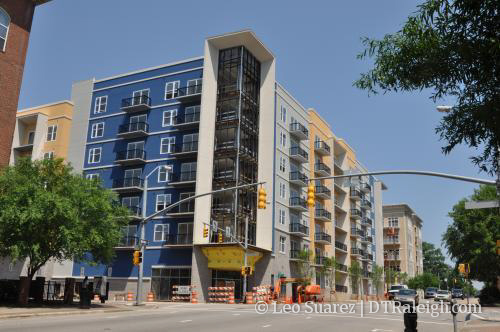
I want to mention The Hue condo building and how it may be a key boost in residential density in downtown. The Hue and its neighbors, Park Devereux and The Dawson, form a cluster of people living close to each other unlike any other area. According to the Downtown Raleigh Alliance, these three buildings have 319 units between them. Spanned across only two blocks, this will be the densest residential area when The Hue opens. (dense by Raleigh standards) Putting their look and architecture aside, I think I like what has been built here. The five to seven story buildings do not feel overwhelming and create a more livable environment compared to a corridor of twenty plus story towers. If another condo building in the seven to ten story range was built across the street from The Dawson, we may have a condo neighborhood district forming.

With a couple hundred or even a thousand homes so close to each other, new types of restaurants and shops may pop up. This location, away from the more ‘touristy’ centers of Fayetteville St. or Glenwood South, should see neighborhood style cheap eats, convenience stores, and could support a small grocery store too. I’m not knocking on some of the great places to eat and drink around Fayetteville St., I spend most of my time there right now. The only problem with the core downtown area is the higher cost, resulting in much higher rents. The places that are now open need to draw in people from outside of downtown and become a destination to be very successful. They also rely heavily on pedestrian traffic. Downtown Raleigh will really reach a new level when we have businesses that can solely survive by the condo-dwellers that live within a few hundred feet around them.

I’d be curious to know if the Urban Design Center has any plans or strategies to encourage this kind of density.

Parking Meters In The Downtown Core

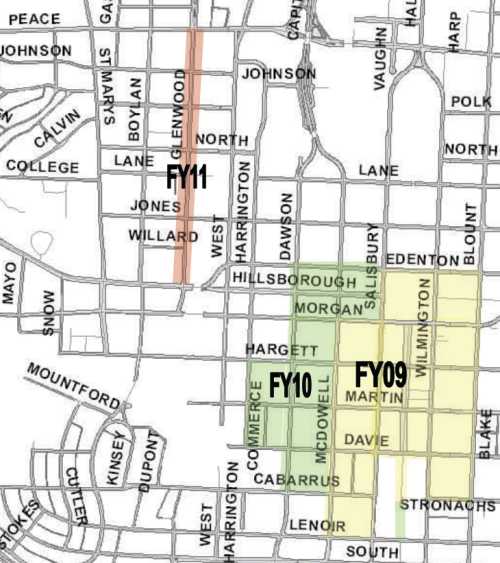
You may have already heard about it but if not, the Raleigh city council has approved the implementation of parking meters in certain areas of downtown. This letter from the Downtown Raleigh Alliance is a key read. To sum up the major points:

  • The first phase could come as early as June 2009.
  • ‘Pay by space’ stations would be used, accepting paper, coin, and plastic.
  • Rates would be $1 for a one hour spot and $2 for a two hour spot.
  • Enforcement time would not change; Mon-Fri, 8am-5pm.

The point is to increase turnover of on street spaces as well as making parking decks more attractive. The rates in decks will not increase and a more uniform hourly rate will eventually be implemented.

What this really means

There are ways to park downtown for free; you just have to know how to work the system. Shockingly, there are people out there that play this game, you know who you are, and the parking meters should stop this. If you want to park downtown for more then two hours you should park in a deck and take advantage of the cheaper rates. With the decks more full, the streets are less crowded and therefore parking is easier. Simple, right?

I had to think this through and I think I get it; charging for on street parking will encourage people to come downtown. I also think it will put to rest the ‘It is so hard to park downtown’ mentality. This only applies to the enforcement time of 8-5 during the week remember. Let me try and paint you a picture.

For a short trip, parking downtown right now involves crowded streets. However, these crowded streets are free so the majority of drivers circle the block and look for that gem of a space to appear. That spot may come, where then I would consider you lucky, but if not most drivers would scream in anger, ‘It is so hard to park downtown!’ Now that that free spot can not be had, driver must pay up and go to a deck a few blocks away in a furious rage (and possibly hurting driver’s image of downtown Raleigh). All that work just to meet a client for a coffee.

Let’s fast forward a couple years after the meters have been installed and driver now has to visit downtown again. The streets are not so crowded as before and a few spots are available. However, this time driver must pay two bucks for two hours. Driver now has two choices, pay the two bucks for the convenience of parking so close or save a little by circling the block and going straight to a deck. Driver decides to pay the two dollars and has a better experience then before because driver is close to the coffee shop.

That story really wasn’t that good and could have gone many ways but it does, sort of, describe a possible scenario in the future. I think the free choice versus cost choice that we have now is not helping. Unfortunately, money wins in this situation and if ALL parking cost money, people would know about that cheaper alternative. When the meters are in full effect, drivers will have two options:

  • Park on the street: Pay more, convenient location
  • Park in a deck: Pay less, walk a little

Each option can never be stressful unless its just one of those days that the entire city wants to come downtown and everything is full (which happens maybe twice a year). Businesses should enjoy the higher turnover on the spots around their block. With more turnover and more available spots, the ‘It is so hard to park downtown’ mentality should diminish and people will start visiting more often.

…..in theory anyway. What do you think?

2009 Downtown Wishlist

Now that the holidays are over, and you now have time to read the blog, we can discuss a couple of ideas for what downtown should have in 2009. What is possible to create within a year’s time that will add to the vibrancy of downtown, serving residents as well as visitors? Here is a short list to get the ideas flowing.

Grocery store

A lot of conversations I’ve had with people considering to move downtown are about the lack of a grocery store in the area. They hesitate to move because of the fact that they still need to get in their cars and drive somewhere. There are not that many residents yet in downtown so it will be a gamble for someone to open the first within the core downtown.

I do believe that if done properly, it can be successful. Most people that visit a suburban grocery store buy enough food for days, some weeks even. If downtown, this store needs to do the opposite and provide me with fresh food and other products for only a couple days. This leads to repeat visits from customers, a much more personal experience, and I really feel that downtown residents will support a locally owned store with local produce.

Music venue

Another music alternative to Lincoln Theatre and The Pour House would be great. It could possibly fill the void ever since King’s was demolished or maybe head in another direction. My guess would be a larger venue but I’m also not into the current market for it. Maybe the demand is not here in this area but I see tours all the time skip over Raleigh completely, at least the music that I’m paying attention too. If they even come to North Carolina, Charlotte usually grabs them and I’m tired of making the 2 hour drive out there and back in one night.

24 hour food

My dream would be some kind of diner that is always open, serving breakfast, lunch, and dinner 24 hours a day. The food does not have to be gourmet at all, more like home-cooked at a reasonable price. Right away, I could see the nightlife crowd lining up until 4am to get some breakfast. It would be the most reliable spot to send people looking for a bite when they check into a hotel late, are up extra early for work, or anyone that doesn’t want to spend much at a restaurant.

By the slice pizza and delivery

If you have been reading RalCon for awhile now, you know my personal desire to see a good, hole-in-the-wall, pizza place. It would be nothing fancy at all except damn good pizza. An added bonus would be delivery in and around downtown. I could see a couple people running all over downtown taking pizza up to the condos or riding bikes out to Oakwood or Boylan Heights making deliveries.

At least one corporate re-location to downtown

The current economy may have a play here but office space is being built in downtown and we need companies to fill them. Charter Square is the obvious candidate and I’d like to hear of at least one announcement of a major company moving to downtown. A couple hundred more employees to the 9 to 5 scene may help the other suggestions above actually happen.

Online Raleigh scene

As a blogger and tech enthusiast, I’d like to see the current internet scene about the city pushed even more. I want more blogs to get started, more pictures to be uploaded, and just more internet chatter about this great city. Video blogging is still in its infancy and podcasting is pretty much silent. If you have any good links or know someone that is doing some interesting work online about Raleigh, post it or let me know about it.