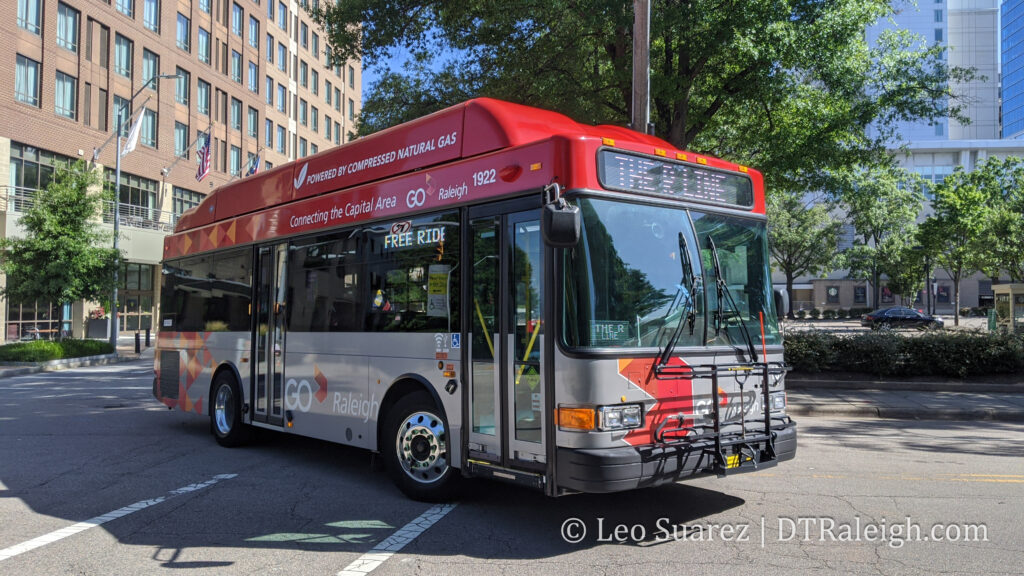
The Raleigh Transit Authority, which I am currently an active member of, has endorsed a plan to rethink the R-Line, our downtown Raleigh bus circulator service. Given low ridership, high cost, and the availability of other mobility options in the downtown area, it may just be time to think differently about how people get around and what needs are not being met. This August, the R-Line will go on sabbatical for a while while the city’s transit staff work on something different — or not, as retiring it completely is still on the table. Let’s take a look at the history and current state of the R-Line.
How It Started
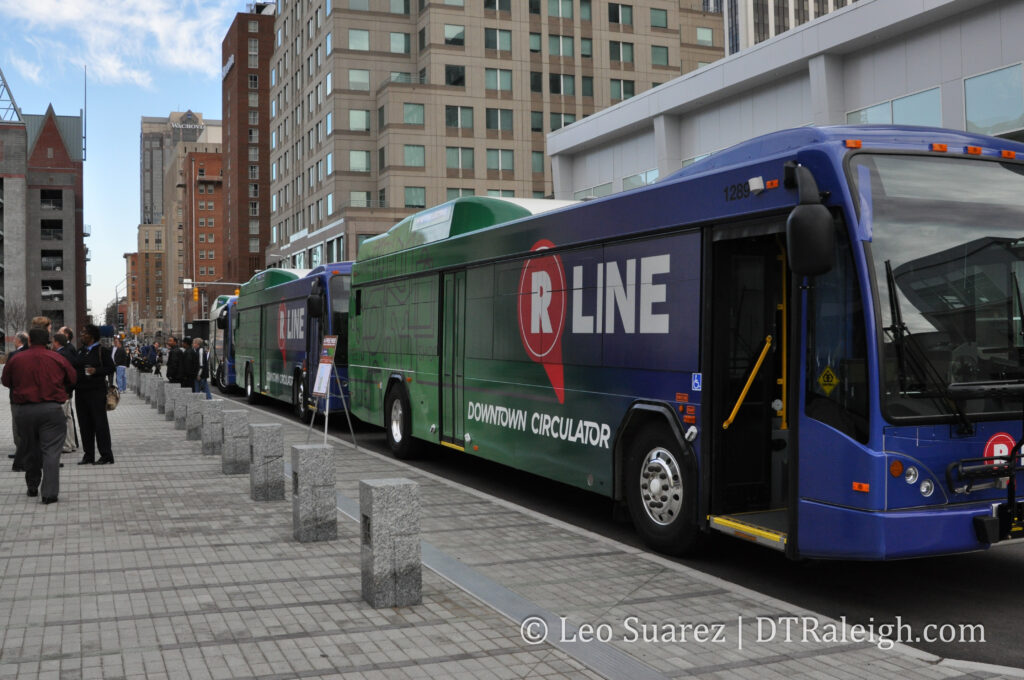
The R-Line is younger than the blog, so I’m fortunate to have it pretty well documented. The service launched in February 2009 and you can relive it in this post here. At the time, downtown had just opened its new Convention Center and the only district with any real density of entertainment options was Glenwood South. The Warehouse District was very quiet, Moore Square was laid back, and Fayetteville Street, while looking fresh after that end-to-end renovation, didn’t yet have that many restaurants open. The desire was to move people from the Convention Center and new Marriott Hotel to Glenwood South, so a downtown circulator fit the bill.
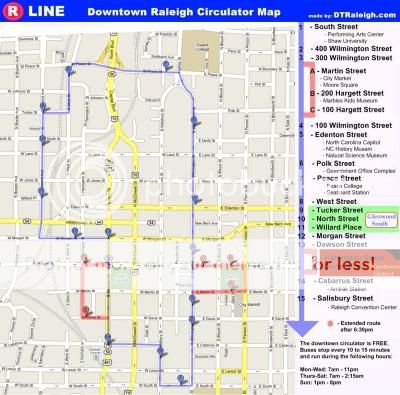
Embedded above was a route map that I made back around the time the service launched. The route operated in a counter-clockwise loop using branded buses. At certain hours of the day (evening) there were spurs that looped around Moore Square and through the Warehouse District. The hours were wide, running buses starting at 7am on most days and on Thursdays through Saturdays, service would go past 2am. It wasn’t too frequent, maybe a bus would roll by every 20 minutes, but I think it was considered a success.
I remember chatter about wanting to extend the R-Line to points further out, like the currently named Village District and Person Street District. There was even mention of an M-Line to get to and from North Hills. Critics shot all this down since GoRaleigh bus routes already covered similar ground, though service and frequency on those routes were a lot different in the early 2010s compared to now.
Peak Ridership and the Decline
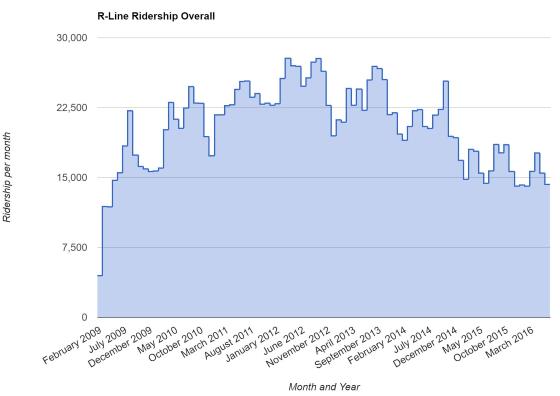
If ridership is your metric, the numbers climbed from 2009 through 2012, with some months seeing almost 30,000 riders. That put the R-Line into the “productive” category as far as transit speak goes. This was peak R-Line, and then ridership flattened and started falling. Throughout the 2010s, alternatives emerged: rideshare services like Uber and Lyft, dockless scooters with Bird being the first to just appear, and the city launched a docked bikeshare system. The theory is that these services offered compelling alternatives to a fixed-route service.
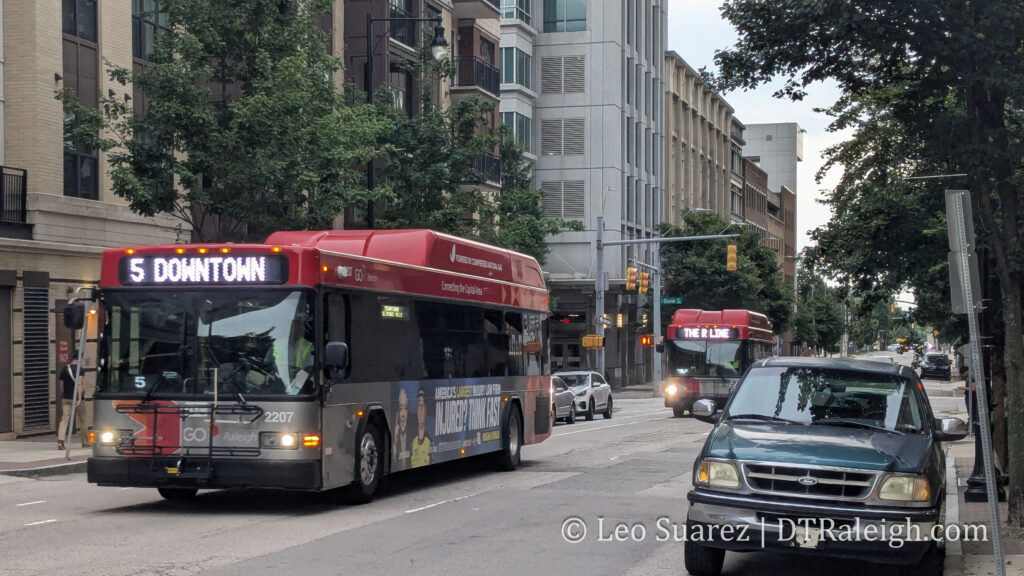
I’ll also add, and this may be speculation, that the branded buses exclusive to the R-Line seemed to be retired at some point. The buses were wrapped with the same red pattern as the rest of the GoRaleigh fleet, which makes operations easier since any bus can now run the R-Line route. I think this is an important detail, which I’ll expand on below.
The Route Change and COVID
With ridership falling, the city took note. In 2019, a route change was implemented. The route ditched the loop and became more of a bidirectional circulator. Here is the map of that new, and still existing, route.
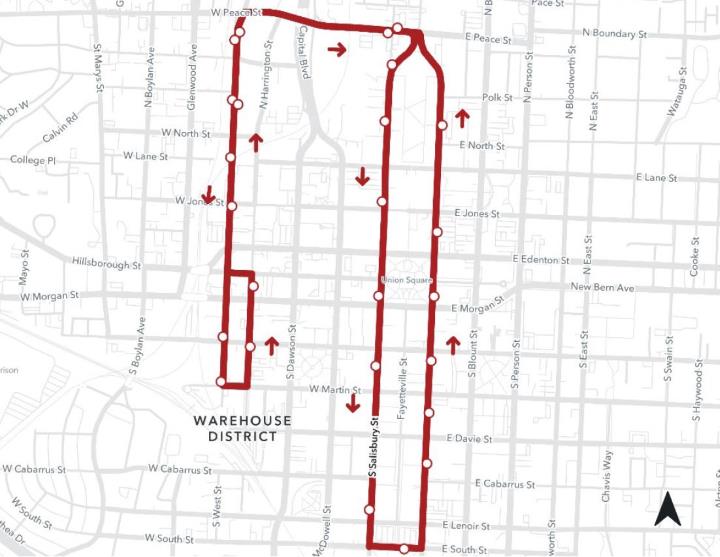
The new route started in late 2019 — an unfortunate time, as the COVID pandemic was right around the corner. Transit agencies, including GoRaleigh, had to adjust quickly. With ridership low and bus drivers stretched thin, the city put the R-Line on hold. That pause held for a few years until it came back in 2024 in the form we’ve seen today.
What Comes Next
So a pause in service is taking place for no longer than 18 months beginning in August 2026. That means the city will spend that time thinking about what should come next. Downtown stakeholders will have a chance to weigh in on what it means to get around downtown Raleigh. Don’t think about this as just a change in route or vehicle. This goes beyond a fixed-route bus — we could potentially fund something completely different.
My take is that the R-Line is operationally competing with our expanding GoRaleigh bus system. In the early days, its success was driven by the fact that there were few other options out there. The rickshaws (can we bring those back, please?) were fun, but a circulator service with a branded look felt like the natural option once you were within downtown. Now we have a bus that blends into the greater system running a route that overlaps existing routes. And it’s a double whammy, because GoRaleigh routes are now offering high-frequency service on top of it. Operationally, the R-Line just doesn’t make sense on paper.
That’s my take, and my opinion alone, that the R-Line got folded into the GoRaleigh operations side of the city when it should be treated more like an extension of our hospitality. I realize we don’t have a Department of Raleigh Hospitality (maybe we should?) but whatever comes next needs to be treated that way. Something more nimble that can respond when we have a big weekend planned, including shows at Red Hat and major conventions at the Convention Center. Drivers who act as hosts, trained to answer general questions about getting around Raleigh and just be friendly and courteous. Connections to Dix Park should absolutely be considered too, since none of the GoRaleigh routes actually go into the park.
What’s also interesting is the trend toward point-to-point options (rideshare, dockless scooters and bikes, etc.) rather than fixed routes, and I think that approach actually suits downtown Raleigh pretty well. We don’t have a main street. There’s no single corridor where you plant yourself and everything just happens around you. What we have is a grid, and the things worth doing are spread across it in a way that sends people off in a dozen different directions depending on what they’re after. That’s a challenge for a fixed-route circulator trying to serve everyone, but it’s also kind of the character of the place. If you know where to look and you’re willing to wander a little, there’s a lot out there. Getting people moving through that grid rather than along one line is a different problem to solve, and maybe a different vehicle to solve it with.
I’ll be very interested to see how things develop and am eager to see a downtown-centric mobility solution take shape for the 2030s, a decade I’m genuinely optimistic about. I plan to dive deeper into that topic in a future post, but I’ll say this: I seriously hope a new mobility option is part of that future.
Comments
Comments are disabled here. That's because we're all hanging out on the DTRaleigh Community, an online forum for passionate fans of the Oak City.