Municipography, Wake County Transit Plan
Municipography is a summary of current issues going through the Raleigh City Council and other municipal departments in the city. The point is to try to deliver any video, photos, and text associated with the discussions happening at City Hall or elsewhere. Since this is a downtown Raleigh blog, the focus is on the center of the city.
Making their way around Wake County is David King, the General Manager of Triangle Transit, and his entourage to present to all twelve of Wake’s municipalities about the Wake County transit plan. Yesterday at their February 7th city council meeting, Raleigh was given the presentation. It was meant for information only and the county is gathering feedback about the plan from citizens as well as city and town leaders.
One core point of the presentation more people need to be aware of is while light rail, commuter rail, and buses are being talked about, two plans actually exist. The “core transit” plan, as it’s called, is the plan that consists of the bus plan and the commuter rail line. It is estimated that this can be covered with local revenue sources only. The “enhanced transit” plan adds the light rail piece to the mix and King makes it clear that state and federal money would be needed to bring this addition to the area.
The feedback will determine whether county leaders put a 1/2 cent sales tax increase on the ballot one day and if voters approve, all the money generated gets funneled to transit these improvements. Here is the video of the presentation in Raleigh with David King and David Cooke, the Wake County Manager, talking transit, money, and future projections.
Here’s a summary from the city’s press release.
A draft plan that recommends major transportation improvements in Wake County, including new commuter and light-rail services, was presented today to the Raleigh City Council.
Wake County Manager David Cooke and David King, general manager of the Triangle Transit Authority, appeared at the City Council meeting to give an overview of the draft Wake County Transit Plan. In addition to Wake County, contributors to the proposed plan were the 12 municipalities in the county, including the City of Raleigh, and area transit providers and agencies.
Raleigh City Council members did not take action on the draft Wake County Transit Plan but accepted it as information. Similar presentations about the draft transit plan are being made to the governing bodies of the county’s other municipalities. Wake County expects to finalize the plan late this spring.
The draft Wake County Transit Plan takes a two-pronged approach to meeting increasing transit needs as the county continues to grow. Wake County’s population, set at about 901,000 in the 2010 U.S. Census, is projected to top 1 million by 2015 and 1.5 million by 2035. The transit plan’s two-pronged approach is:
- A Core Transit Plan that would expand local and commuter bus service and build a rush-hour 37-mile commuter rail service from Garner to Durham. It would also provide amenities such as park-and-ride lots, sidewalks, signage and bus shelters, benches and other improvements; and,
- An Enhanced Transit Plan that would build light-rail service from Downtown Cary through Downtown Raleigh, up to Millbrook Road in north Raleigh. The route would cover 13.9 miles.
Wake County’s share of the of the five-year bus services improvements in the plan would be $138.3 million of the total $344 million needed for both capital and operating costs. The remaining funds would come from state and federal funds. The commuter rail service would cost $650 million, with Wake County’s share at $330 million and Durham County’s at $320 million. The commuter rail system is projected to begin operations in 2019 or 2020.
Twelve (12) stations are proposed for the commuter rail system, including four in Raleigh. The four Capital City stations would be located along railroad tracks at the following locations:
- West Raleigh north of Hillsborough Street near Corporate Center Drive;
- North Carolina State University;
- Downtown Raleigh near West and Davie Streets; and,
- Hammond Road/Rush Street area in south Raleigh
The proposed light-rail service would cost $1.1 billion, with most of the funding coming from state and federal sources. The light-rail system would have 16 stations, including 14 stations in Raleigh. The Raleigh station locations would be:
- West Raleigh Station near Corporate Center Drive and Chapel Hill Road;
- Jones Franklin Road Station;
- State Fairgrounds Station;
- Gorman Street Station;
- North Carolina State University/Dan Allen Drive Station;
- North Carolina State University/Pullen Road Station;
- West Morgan Street Station;
- Union Station-Morgan/Hargett Station in Downtown Raleigh;
- Harrington Avenue Station between Lane and Jones streets in Downtown Raleigh;
- Peace Street Station;
- Whitaker Mill Road Station;
- Six Forks Road Station;
- New Hope Church Road Station; and,
- Millbrook Road Station.
Local revenue sources to pay for the transportation improvements proposed in the draft Wake County Transit Plan would include:
- A half-cent sales tax increase which would need approval by Wake County voters in a referendum. The Wake County Board of County Commissioners would schedule the referendum; and,
- A $10 increase in annual vehicle registration fees. County commissioners have the authority to establish a new $7 vehicle registration fee, with the revenue going toward funding the transit plan. The board of trustees of Triangle Transit can increase the regional vehicle registration fee by $3 also to fund the transit plan. The current annual vehicle registration fee in Raleigh is $35. A $10 increase would raise the fee to $45.
To view the draft Wake County Transit Plan, visit the county’s website at www.wakegov.com and type “Wake County Transit Plan” in the search engine, or call 856-6160.
Demolition Underway For 400 Glenwood South Apartments
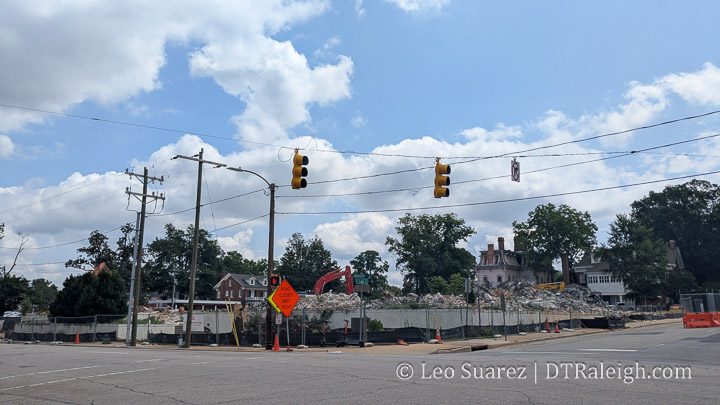
During a walk this past gloomy weekend, I got a chance to see some of the demolition going on along St. Mary’s and Tucker Street. The rental market is huge these days and developers are reacting not far from the main drag of Glenwood South. About 400 apartments between two new developments will start to be put together after the land has been fully cleared.
The now called St. Mary’s Square will bring about 145 apartments along the southern block bounded by St. Mary’s Street, Johnson, and Gaston Street. We’ve gone over the site plan before and now that land clearing looks almost done, construction should begin soon.
Click on the image below for a gallery of before and after photos of parts of the 600 block of St. Mary’s Street.
E-mail and RSS readers, jump to the post on the web to see the full gallery of images.
Across the Street from the currently completed apartment building, 712 Tucker, 425 Boylan will be built. Currently, houses have been removed along the south side of the 700 block of Tucker Street and once the land is cleared, the 7-story, 250 apartment building will be put together. The mixed-use building also includes 13,000 square feet of commercial space along the ground floor.
Below is another gallery of images.
Glenwood South may have the highest population density in Raleigh in a few years. Take Note.
DT Raleigh Chatter for February First Friday 2012
Filling Empty Spaces The BEST Way Possible

The Hue storefront on January 29th
A fun scavenger-hunt style post series I have are a few that talk about empty storefronts in downtown that should be filled with businesses. The latest was written back in May 2011 and I don’t think it’s been long enough for an update. Click on the link to visit that conversation and previous years:
- 2011 Top Places of Empty Spaces, Filling Retail Space In Downtown (May 25th, 2011)
There’s a new twist on the space filling front in downtown Raleigh and it’ll be unveiled during February’s First Friday, coming up on the 3rd. Beautifying Emerging Spaces Together, or BEST, has been meeting up for the past few months and they are ready to show off their first installment.
But before I get into that, I need explain what BEST is exactly. From a post on the Raleigh DLA blog, Donna Belt writes:
Two months later, I’m ready to introduce BEST, a team of Downtown Raleigh residents, business leaders and artists who have come together with the mission of BEAUTIFYING EMERGING SPACES TOGETHER. Our vision has morphed and grown according to the imagination and individual skills of each person who has joined our table, often over coffee at the Wilmoore Cafe.
With these empty spaces creating gaps around our downtown the question arises about what can be done while we wait for the businesses to invest in them?
In my mind, an empty space adds nothing to the sidewalk experience. It’s not interactive. There’s no reason to stop and stay awhile. People just pass on by and ignore it. Rather than wait for a shop or restaurant to come, why not activate the spaces until that business sets up one day?
The BEST team is putting that together and property owners are at the table with artists, residents, and business leaders. The idea is for the team to work within the current bounds, be it financial, legal, etc., and try to do something, anything that is allowed in the space. Art installations may be first but down the road, who knows.
The main point, and one of the big reasons why I’m into this project, is that it is a community driven project. Some readers may be aware of last year’s Mordecai Barbershop Art Gallery installation, a collaboration project between citizens of the Mordecai neighborhood and the property owner. A face lift was given to an empty space on Person Street made possible entirely on volunteers from the community. This is a grassroots example of taking pride in where we live and doing something to enhance the places we go by all the time.
I wish the BEST of luck to the team and look forward to the growth of the project.
![]() |
Read about BEST on the project website, RaleighEmergingSpaces.com
Follow BEST Raleigh on Facebook. |
Patting Myself On The Back Day, 5 Years of RalCon

Five years and going strong.
Looking Back at 2011 Article in the Raleigh Downtowner
I contributed to the latest edition of the Raleigh Downtowner Magazine with an article that looks back at our city’s progress in 2011. Many of the items that I go through are happening in downtown and have been mentioned on this blog before.
Pick up a copy and check it out or read it online.
Looking Back at 2011 – via Raleigh Downtowner
DT Raleigh Chatter for January 27th, 2012
Pic of the Week

The Walk Raleigh project is brought to you by the good folks at CityFabric. Their latest tweet is interesting, with an equivalent Facebook post mentioning more permanent signs.